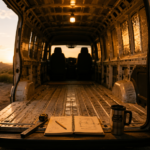

So you’re thinking about packing the kids into a van and hitting the road. Maybe you’ve spent too many evenings down a YouTube rabbit hole watching families homeschool their children on clifftops and cook pasta on a two-ring hob while the sun sets over the sea. And now you’re wondering: is any of this actually real? Or is it all just carefully edited content?
The truth, as usual, sits somewhere in the middle.
We’ve pulled together the most common questions parents ask in forums, Reddit threads, and Facebook groups before taking the plunge — and answered them the way experienced van life families actually do. No fluff, no filters.
“How on earth do you handle schooling on the road?”
This is the question that stops most parents in their tracks. And it’s a fair one.
In the UK, you have a legal right to home educate your children. You don’t need a qualification, a curriculum, or permission from anyone — you simply need to notify the school if your child is already enrolled, and that’s it. Most van life families in the UK use a mix of approaches:
Structured home education using resources like Oak National Academy (free), Twinkl, or Khan Academy for older kids. Many parents do “school hours” in the morning — two to three focused hours — and spend the rest of the day learning through doing.
World schooling is what a lot of families land on naturally. History taught at an actual castle. Geography learned by reading maps and crossing borders. Maths done through budgeting the weekly shop. Kids absorb an enormous amount when they’re not sitting behind a desk.
Secondary age kids are trickier. GCSEs require more structured input, and some families use online tutors or distance learning programmes like Interhigh or Wolsey Hall Oxford for this stage.
The real talk from parents on Reddit? Most say their kids are ahead academically within six months, not behind. Fewer distractions, more one-to-one time, and genuine curiosity do more than a classroom ever could — for most children.
“Is it actually safe for kids?”
Let’s deal with the fear head-on.
The honest answer from families who do it: yes, with the right set-up, it is safe. But it requires deliberate thought.
The biggest practical safety concerns parents raise in forums are:
Carbon monoxide. Non-negotiable. Fit a CO alarm. If you have a diesel heater, gas hob, or any combustion appliance, this is the single most important thing you can do. Buy a quality alarm, test it monthly, and replace it every five years.
Child seats and travel. Kids travel in proper seats, the same as any car journey. This is obvious but worth saying — some conversion vans tempt people to add rear-facing benches. Don’t. Use approved seats bolted to the van’s frame.
Secure storage. Anything heavy that isn’t bolted down becomes a projectile in a crash. Families report spending serious time on securing storage, kitchen equipment, and tools before they felt confident with kids aboard.
Road safety awareness. Surprisingly, this one comes up a lot in a positive way. Kids who travel in vans tend to develop excellent road awareness, map-reading skills, and a healthy respect for traffic early on.
The lifestyle is not inherently more dangerous than conventional life. If anything, van life families tend to be more safety-conscious, precisely because the stakes feel higher.
“What happens when a child gets sick?”
This is the one that worries parents most — and it’s also the one that turns out to be less of a disaster than they expect.
The NHS is available to you wherever you are in the UK. You can register as a temporary patient at any GP surgery. Many families use 111 as their first port of call and have found it genuinely helpful on the road. A&E is everywhere.
Practically speaking, most van life parents carry a well-stocked first aid kit: children’s paracetamol and ibuprofen, antihistamines, rehydration sachets, plasters, a thermometer, and any regular prescriptions with a good supply buffer.
The harder truth? A sick, miserable child in a small space is genuinely tough. There’s nowhere to retreat. One parent in a Facebook group described it as “the van shrinks to the size of a cupboard the moment someone gets a fever.”
Families get through it the same way they would at home — with patience, snacks, and a lot of children’s TV downloaded offline. The difference is you might be parked in a layby rather than on your sofa. Most parents say after the first illness on the road, they stop dreading it. You manage. You cope. And then you move on.
“Toddlers vs teenagers — is one easier than the other?”
Short answer: they’re hard in completely different ways.
Toddlers and young children are, in many ways, perfectly suited to van life. They don’t care about space. They want to be near you. They’re endlessly entertained by new environments, animals, and puddles. The hardest part with toddlers is nap schedules (a moving van is excellent for this, actually), childproofing a small space, and the total absence of anywhere to put them down safely while you set up camp.
Families with under-5s consistently say: keep a playpen or travel cot, carry a sling or carrier, and embrace the chaos. It’s manageable, often joyful, and surprisingly good for small children.
Teenagers are a different challenge entirely. They need:
- Space and privacy. A dedicated sleeping area that’s theirs, ideally with some kind of curtain or partition.
- Social connection. This is the big one. Teenagers crave peer relationships, and van life can feel isolating. Families who make it work with teens are deliberate about finding van life communities, attending meet-ups, and staying in one place long enough for friendships to form.
- Internet access. Homework, friends, YouTube, gaming. Data is the currency of teenage cooperation. Invest in a good mobile router.
- Input into the plan. Teenagers who have a say in where you go, what you do, and how long you stay somewhere are far more engaged than those who feel dragged along.
The families who struggle most with teenagers are the ones who underestimate how much teens need autonomy. The ones who thrive involve their kids in the adventure as active participants, not passengers.
Myths vs reality: what the forums actually say
Myth 1: “Social services will take your kids.” Reality: This comes up constantly and it’s almost entirely unfounded. Home education is legal. Van dwelling is legal. Families report occasional interest from curious people or, very rarely, a welfare check — but these are resolved quickly when it’s clear the children are safe, loved, and learning. In thousands of posts across UK van life communities, cases of genuine intervention are virtually non-existent.
Myth 2: “Kids will resent you for it.” Reality: The overwhelming majority of parents who ask their children years later report the opposite. Kids cite van life as formative, adventurous, and something they’re proud of. A minority of children — particularly socially anxious teenagers or children who crave routine — do find it harder. Knowing your child matters more than assuming they’ll thrive or struggle.
Myth 3: “You need a massive, expensive van.” Reality: Families of four have successfully lived in a standard Volkswagen Transporter. It’s tight. It requires organisation. But it works. A bigger van makes life more comfortable, but it’s not a prerequisite. Many families start small and upgrade later — or discover they don’t need to.
Myth 4: “It’s selfish to put kids through this.” Reality: This one comes mostly from people who haven’t done it. Parents who’ve raised children on the road consistently describe kids who are resilient, adaptable, curious, and confident in social situations. Travel, novelty, and unconventional living aren’t deprivation — for most children, they’re an education in the truest sense.
Quick-start checklist for families thinking about van life
Before you commit, work through this list honestly:
Legal & admin
- [ ] Notify school and register as home educators if relevant
- [ ] Update vehicle insurance to include family/full-time living
- [ ] Arrange a mail forwarding address (family member, or a service like UK Postbox)
- [ ] Register with a GP surgery as a temporary patient system user
Van set-up for kids
- [ ] Approved child car seats bolted to the van structure
- [ ] Carbon monoxide alarm fitted and tested
- [ ] All heavy items secured or in locked storage
- [ ] Dedicated sleeping space per child (bunk builds are popular for two kids)
- [ ] Offline entertainment downloaded (films, audiobooks, games)
Education
- [ ] Choose a basic curriculum or resource set (Oak National Academy is free)
- [ ] Set up a “school rhythm” — even 2 hours a day structured learning helps
- [ ] Research online tutors if you have secondary-age children
Health
- [ ] First aid kit stocked for children (paracetamol, ibuprofen, rehydration sachets)
- [ ] Prescription medicines with at least one month’s buffer supply
- [ ] Save 111 in your phone contacts
Mental prep
- [ ] Have a honest conversation with your kids — get their input
- [ ] Join at least one UK van life family community before you start
- [ ] Agree on a “this isn’t working” clause with your partner — a plan B takes pressure off
The bottom line
Van life with kids is not for every family. It takes organisation, flexibility, and a genuine tolerance for small spaces and imperfect days. It’s not the paradise of Instagram, and it’s not the chaos of a cautionary tale either.
What parents who actually do it say, more than anything else, is this: the hard parts were survivable, and the good parts were better than they imagined. Their kids adapted faster than they did. The lifestyle changed them all — mostly for the better.
If you’re on the fence, the best advice from the van life community isn’t “just do it.” It’s “do a trial run first.” A month in a hired campervan with the whole family tells you more about whether this is your life than a year of research ever will.
Are you a family currently living the van life — or thinking about it? Leave your biggest question in the comments and I’ll do my best to answer it from real experience.