
More Than Just a Floor Covering
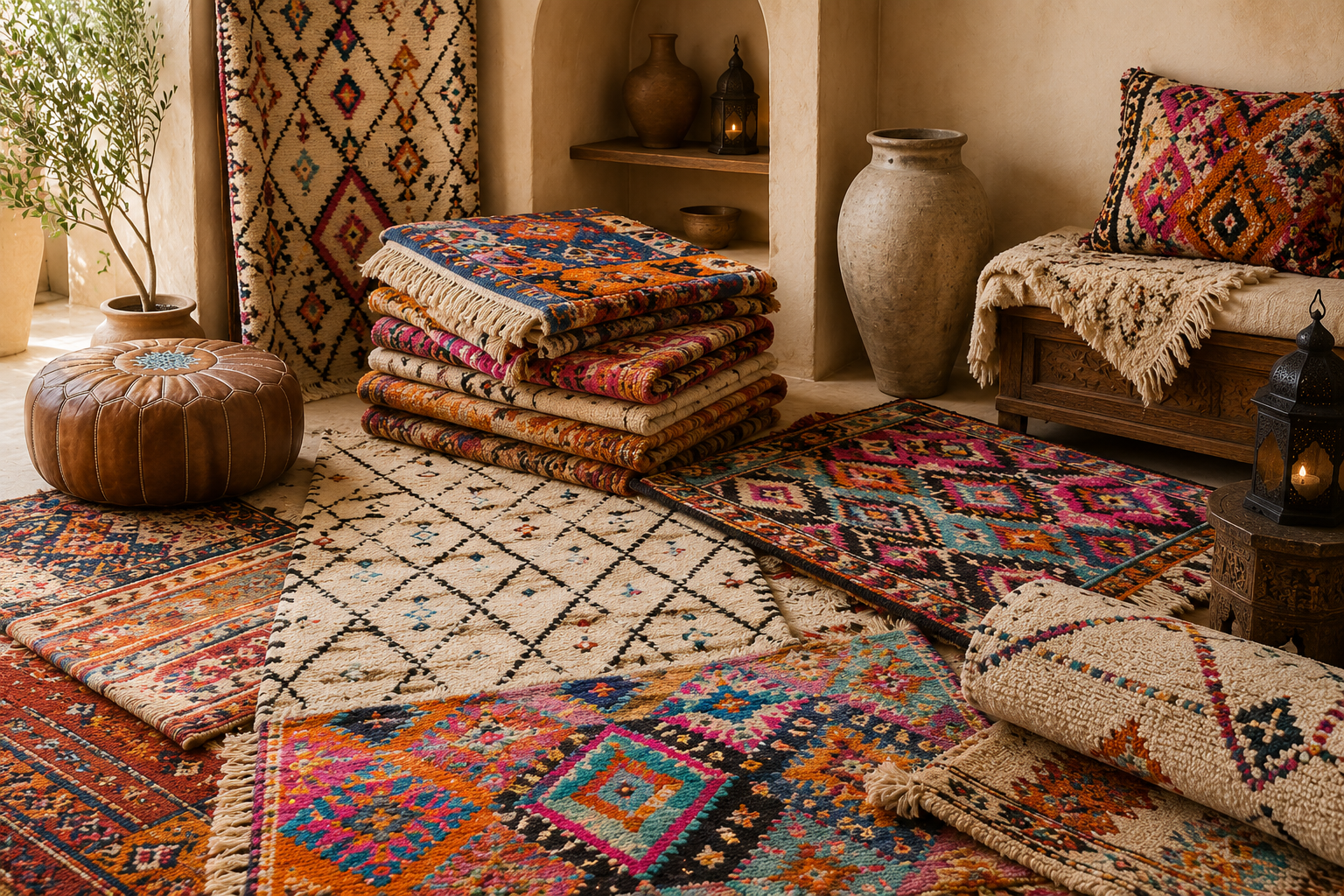
There is a moment that happens to almost every visitor in a Moroccan souk. You round a corner, duck under a low archway, and suddenly you are standing in front of a wall — or a ceiling, or an entire alleyway — draped in rugs. Ivory wool piled thick as a cloud. Geometric diamonds in saffron and indigo. Shaggy Beni Ourain pieces that look like they belong in a Copenhagen design studio and a High Atlas village at the same time.
Moroccan rugs have conquered the global design world, appearing in the pages of Architectural Digest, the floors of Parisian apartments, and the Instagram feeds of interior designers from São Paulo to Seoul. But their appeal runs far deeper than aesthetics. Every rug is a textile diary — woven by hand, often by a single woman or a small cooperative of women, encoding personal symbols, tribal memory, and lived experience into wool and knots.
This guide will take you from the history of Berber weaving to the souks of Marrakech and Fez, helping you understand what you are looking at, how it was made, what it is worth, and how to bring one home without regret.
History & Origins: Threads of the Amazigh World
The story of Moroccan rugs begins with the Amazigh people — known historically as Berbers — the indigenous inhabitants of North Africa whose civilization predates the Arab conquests of the 7th century by thousands of years. For the Amazigh, weaving was never merely craft. It was language.
In communities scattered across the Middle Atlas, the High Atlas, the Rif Mountains, and the pre-Saharan plains, women wove rugs that communicated things that could not always be spoken: fertility prayers, protection from the evil eye, records of marriage and childbirth, expressions of grief and joy. Each tribe developed its own visual vocabulary — a set of symbols so localized that an experienced eye can identify not just the region but sometimes the specific village a rug came from.
For centuries, these rugs were made for domestic use: sleeping mats, saddle blankets, wedding gifts, burial shrouds. It was only in the 20th century, when French colonial administrators began cataloguing and trading Moroccan textiles, that the outside world took serious notice. Mid-century modernists — including Le Corbusier and later the downtown New York art scene — were transfixed by the abstract geometric patterns that seemed to anticipate avant-garde painting. By the 1960s and 70s, the global market for Moroccan rugs had ignited. It has never cooled.
Types of Moroccan Rugs: A Tribal Atlas
Morocco’s rug-making traditions are astonishingly diverse. Here are the styles you are most likely to encounter, and what sets each one apart.
Beni Ourain
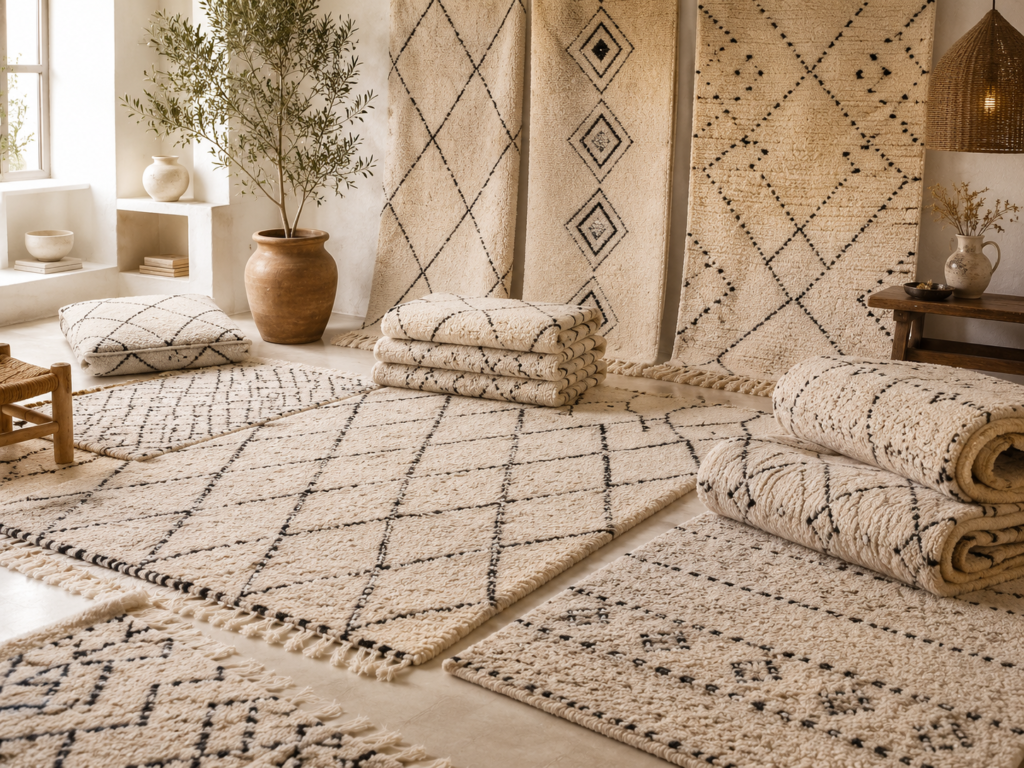
Origin: Middle Atlas Mountains, from the Beni Ourain confederation of tribes.
Look: Thick, lush, ivory or cream pile with bold black or dark brown geometric lines — diamonds, lozenges, abstract forms. Minimalist and immediately recognizable.
Materials: Undyed natural sheep’s wool, usually very high quality.
Best for: Contemporary and Scandinavian interiors; bedroom floors; layering under a coffee table.
Beni Ourain rugs are the most internationally famous Moroccan style, and for good reason. The deep pile — sometimes two inches thick — is extraordinarily warm and soft underfoot. Authentic pieces are woven from the wool of sheep raised at high altitude, which produces a particularly dense and lustrous fiber.
Azilal
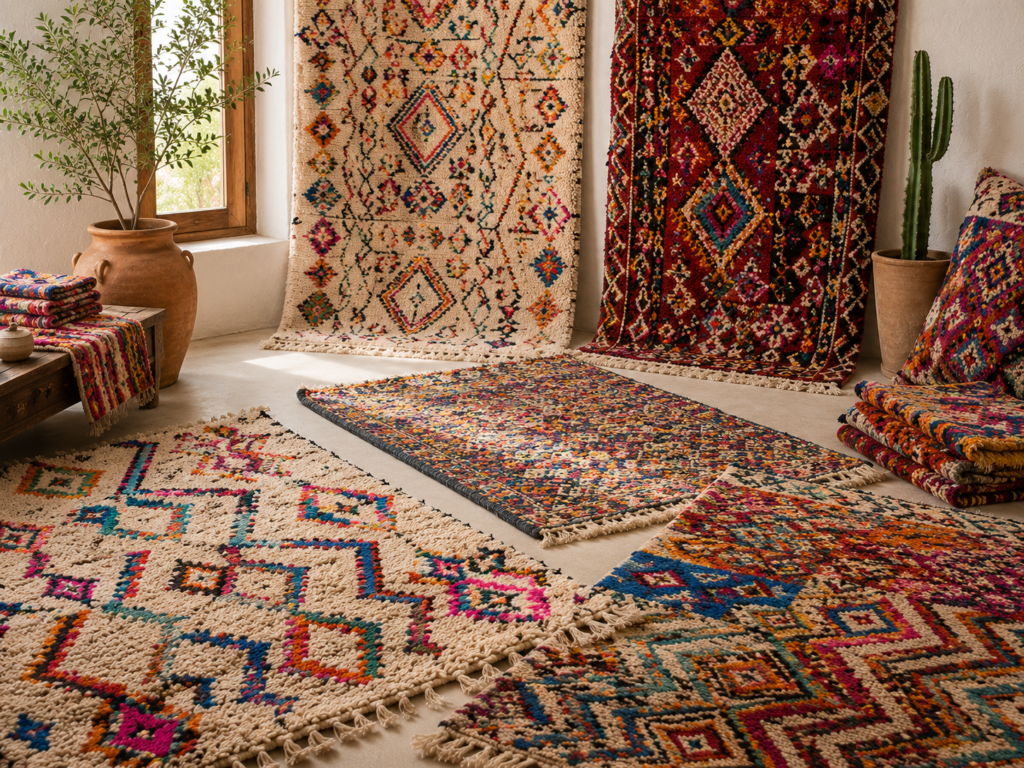
Origin: Azilal Province, High Atlas.
Look: Colorful, playful, abstract. Often featuring irregular symbols, stick figures, small animals, and improvisational compositions on a cream or white background.
Materials: Wool, sometimes mixed with cotton or synthetic threads in older or transitional pieces.
Best for: Bohemian, eclectic, or maximalist spaces; children’s rooms; anyone who wants a rug with genuine personality.
Azilal rugs feel like folk art. No two are remotely alike. The weaver’s individual voice comes through clearly — you might find a small bird in one corner, a comb motif running along the border, and a cluster of diamonds that feel more like doodling than formal design. That spontaneity is exactly the point.
Boucherouite
Origin: Various regions across Morocco.
Look: Wildly colorful, made from recycled fabric strips rather than wool. Often chaotic, joyful, and visually explosive.
Materials: Repurposed cotton, nylon, and synthetic fabric scraps.
Best for: Eclectic or artsy interiors; spaces that can handle visual drama; collectors interested in vernacular textile art.
Boucherouite (pronounced boo-sheh-REET) rugs were born from necessity. When wool was too expensive, women in poorer communities began weaving with whatever fabric they had — old djellabas, scraps from clothing markets, remnants of factory textiles. The result is a rug tradition that is entirely its own: maximalist, zero-waste, and visually unlike anything else in the rug world.
Kilim (Hanbel)
Origin: Nationwide, with strong traditions in the south and east.
Look: Flat-woven, reversible, with bold geometric patterns in earthy or jewel tones. No pile.
Materials: Wool, sometimes cotton or silk accents.
Best for: Warm climates; wall-hanging; layering; high-traffic areas.
Moroccan kilims — called hanbel locally — are among the most underrated rugs in the country. Because they lack the thick pile of a Beni Ourain, they are sometimes overlooked. But their graphic clarity, their reversibility, and their durability make them extremely practical. A good hanbel will outlast almost any other rug type.
Mrirt
Origin: Mrirt, a small town in the Middle Atlas near Khenifra.
Look: Plush pile with pastel or muted tones — soft pink, dusty blue, sage green — arranged in abstract or loosely geometric compositions.
Materials: Fine wool, often very soft.
Best for: Luxury interiors; bedrooms; anyone who loves the texture of a Beni Ourain but wants color.
Mrirt rugs are sometimes called the “colored Beni Ourains,” and while that is an oversimplification, it gives you the right idea. They have the same generous pile and the same commitment to high-quality wool, but the palette is far more varied.
Taznacht
Origin: Taznacht and the Souss-Massa region in southern Morocco.
Look: Rich, saturated colors — deep red, orange, saffron yellow — with tight geometric patterns and fine craftsmanship.
Materials: Wool, frequently dyed with both natural and chemical dyes.
Best for: Traditional, maximalist, or globally-inspired interiors.
Zemmour
Origin: Zemmour tribe, Middle Atlas.
Look: Predominantly red backgrounds with intricate repeating geometric patterns in contrasting colors. Often features dense, all-over designs with small diamond and lozenge motifs.
Materials: Wool.
Best for: Traditional or global interiors; dining rooms; spaces that need a strong focal point.
Symbols & Patterns: Reading the Rug
Moroccan rug motifs are not decorative accidents. They are a symbolic system — imperfect, evolving, and deeply personal, but grounded in shared Amazigh visual culture.
The diamond (lozenge): The most universal motif. Representing femininity, fertility, and protection, it appears in nearly every Amazigh weaving tradition in some form.
The eye: A direct invocation of protection against the evil eye (ayn). Often embedded within diamond shapes or rendered as a standalone motif.
Zigzags and chevrons: Associated with water and rivers — symbols of life, abundance, and purification.
The comb: A symbol of femininity, cleanliness, and sometimes marriage.
Animal forms: Birds (freedom, the soul), fish (luck and prosperity), scorpions (protection — to ward off real scorpions). Often rendered in highly stylized or abstract forms that only become recognizable once you know what you are looking for.
It is worth noting that these meanings are not fixed or universal. Symbols shift between tribes, between generations, and between individual weavers. A diamond that means fertility in one village may carry an entirely different resonance twenty kilometers away. This ambiguity is a feature, not a flaw — it reflects the living, breathing nature of the tradition.
Materials & Dyeing Techniques: What Goes Into the Wool
Wool quality varies dramatically. The best Moroccan rugs use locally-sourced, hand-spun wool from sheep raised in mountain conditions — denser, oilier, and more resilient than lowland wool. As you move down the quality ladder, you encounter machine-spun wool (uniform but less characterful), blended wool-cotton, and fully synthetic fibers (cheap, shiny, not worth buying).
Natural dyes produce colors that are warm, complex, and that age beautifully. Traditional sources include:
- Indigo for blues
- Saffron and pomegranate rind for yellows and golds
- Henna for oranges and warm browns
- Cochineal (imported, but historically used) for deep reds
- Walnut husks for dark browns and blacks
Chemical dyes, introduced in the 20th century, produce brighter and more consistent colors but can fade unevenly and look flat over time. Many modern rugs use a mix of both. Neither is automatically “bad” — but knowing the difference helps you evaluate what you are paying for.
How to test: Rub a damp white cloth firmly against the rug. Some minor color transfer is normal; heavy bleeding suggests low-quality or improperly fixed dye.
How Moroccan Rugs Are Made: The Hands Behind the Craft
Most high-quality Moroccan rugs are hand-knotted or hand-woven by women working in their homes or in small village cooperatives. It is slow, skilled work. A medium-sized Beni Ourain rug might take one weaver three to six weeks to complete. A large, intricately patterned piece can take several months.
Hand-knotting (used for pile rugs like Beni Ourain and Mrirt): Individual knots of wool are tied around the warp threads, row by row, then trimmed to create the pile. The knot count determines density and durability.
Flat-weaving (used for kilims and some Azilal rugs): Weft threads are woven horizontally through the warp without additional knots, creating a thinner, reversible fabric.
Boucherouite uses a loop-and-cut technique similar to hand-knotting but with strips of recycled fabric rather than wool yarn.
The vast majority of weavers are women. In many Amazigh communities, weaving is passed down from mother to daughter, beginning in childhood. Cooperatives — increasingly common since the 1990s — provide weavers with fair wages, shared equipment, and access to export markets that would be impossible to reach individually.
How to Identify an Authentic Moroccan Rug
The global demand for Moroccan rugs has created a thriving market in imitations — machine-made rugs designed to look handmade, or mass-produced pieces falsely marketed as vintage or tribal.
Signs of authenticity:
- Irregular edges and asymmetry. Handmade rugs are never perfectly rectangular. If the edges are laser-straight and every corner is a perfect right angle, be suspicious.
- Variations in pile height. Machine-made rugs have perfectly uniform pile. Handmade rugs have slight variations that catch light differently at different angles.
- Knot backs. Flip the rug over. On a genuine hand-knotted rug, you can see and feel individual knots. A machine-made rug will have a uniform, fabric-like backing — or a glued-on felt back designed to hide the absence of knots.
- Color variations (abrash). Slight shifts in color tone across the rug — called abrash — occur naturally when different batches of dye or different hanks of wool are used. They are a hallmark of authenticity, not a defect.
- Ask questions. A reputable seller should be able to tell you the tribe or region of origin, the approximate age, and the materials used. Vague or evasive answers are a red flag.
Buying Guide: Souks, Prices, and the Art of the Negotiation
Where to buy:
- Marrakech: The souks of the Medina — particularly around Rahba Kedima and the carpet souk near the Mouassine Fountain — offer enormous selection. Quality varies wildly. So do starting prices, which are often inflated for tourists.
- Fez: The Fez el-Bali medina has excellent rug merchants, often with more nuanced knowledge of provenance than their Marrakech counterparts.
- Cooperative showrooms: Buying directly from a women’s cooperative (look for ANAPEC or government-certified cooperatives) guarantees fair producer wages and often provides authenticity documentation.
- Online: Platforms like 1stDibs, Etsy, and specialist dealers (Beni Rugs, Loom & Field, etc.) offer curated selections with transparent pricing. Good for research even if you plan to buy in person.
Price expectations:
- Small Azilal or Boucherouite (3×5 ft): $150–$400
- Medium Beni Ourain (5×8 ft): $400–$1,200
- Large vintage piece (8×10 ft or above): $1,000–$5,000+
- Antique or museum-quality rugs: Well beyond this range
On negotiation: In Moroccan souks, bargaining is expected and is part of the cultural exchange — not an adversarial act. A reasonable starting counter-offer is 40–50% of the asking price. Move slowly, express genuine interest, and do not be afraid to walk away. Walking away is often when the real negotiation begins. That said: pay a fair price. The person who wove the rug worked for weeks or months. The goal is a price that feels good for both parties.
How to Style Moroccan Rugs at Home
Moroccan rugs are among the most versatile textiles in interior design because they carry their own visual authority while remaining surprisingly easy to live with.
In a minimal or Scandinavian space: A classic ivory Beni Ourain with dark geometric lines provides warmth and texture without visual clutter. Let it be the room’s focal point.
In a bohemian or maximalist space: Layer a colorful Azilal over a flat-woven kilim. Mix patterns confidently — Moroccan rugs were designed for visual richness.
On the wall: Vintage kilims and Zemmour rugs are exceptional as wall textiles. Use a rug hanging rod or a simple dowel threaded through the fringe.
In outdoor or high-traffic areas: Flat-woven kilims and Boucherouite rugs handle foot traffic well and can be easily spot-cleaned.
Care & Maintenance: Keeping Your Rug Alive
- Regular care: Shake or beat the rug outdoors every few months. Vacuum on low suction, avoiding the fringe.
- Spot cleaning: Blot spills immediately with a clean cloth. Use cold water and a mild soap if needed. Never rub — always blot.
- Deep cleaning: Take the rug to a specialist rug cleaner every few years. Avoid steam cleaning, which can shrink wool and loosen knots.
- Sun fading: Rotate the rug seasonally if it receives direct sunlight. All dyes — natural and chemical — will fade with prolonged UV exposure.
- Storage: Roll (never fold) the rug around an acid-free tube. Wrap in breathable fabric — not plastic, which traps moisture and encourages mildew.
A Living Piece of Culture
A Moroccan rug is not a purchase. It is an acquisition — of a handmade object that carries within it the labor, knowledge, and creative voice of the woman who made it, the community she belongs to, and a weaving tradition that stretches back thousands of years.
The global design world has been in love with these rugs for decades, and that affection shows no sign of fading. But the best reason to own one has nothing to do with trends. It has to do with the particular pleasure of living with something that was made slowly, by hand, with intention — something that will age beautifully, outlast its owner, and carry its symbols forward into rooms its maker will never see.
Buy the one that speaks to you. Learn where it came from. Pay a fair price. And walk on it every day.