

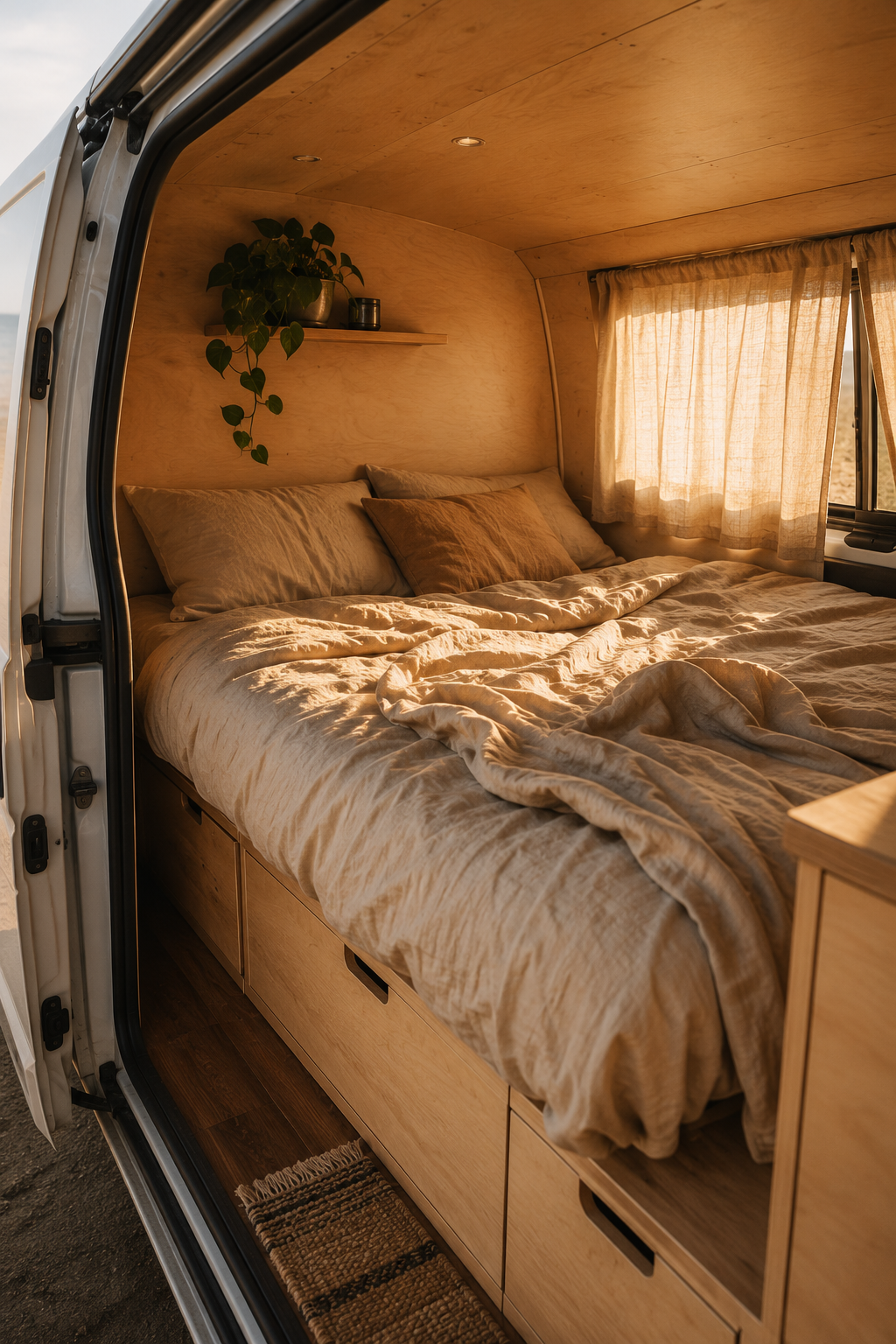
There is a specific kind of morning that van life people talk about in hushed, almost reverent tones.
You wake up slowly. The light coming through the linen curtain is soft and golden — the particular quality of early sun that only exists in the first twenty minutes after sunrise. The duvet is warm and slightly heavy in the way that good bedding always is. Outside, you can hear nothing except birds and, somewhere distant, water. The van smells faintly of last night’s candle and the cedar wood of the panelling. Your coffee is thirty seconds away.
You are in a space that measures roughly eight feet by five feet. And it is, without question, one of the most beautiful rooms you have ever woken up in.
This is not an accident. It is not luck. It is the result of a series of deliberate design decisions made by someone who understood that small spaces are not the enemy of beauty — they are, when handled well, its ideal canvas.
This post is about those decisions. Specifically, about creating a van bedroom in the warm minimalist style — a look and a feeling that has become the defining aesthetic of thoughtful van life design, and one that is far more achievable than it looks on Instagram.
The Warm Minimalist Design Philosophy for Van Bedrooms
Before you buy a single piece of linen or cut a single plank of wood, it helps to understand what warm minimalism actually means — because it is frequently misunderstood.
Warm minimalism is not about having less. It is about choosing deliberately. It is the difference between a van bedroom that feels empty and cold, and one that feels calm and intentional. The edit is strict, but every item that makes the cut earns its place through beauty, function, or both.
There are five pillars that hold the whole thing up.
Warm neutral palette. Every color in the space should lean toward warmth — cream, oat, sand, terracotta, warm taupe. Never cool grey, never stark white, never anything that reads as clinical. The palette should feel like it belongs outdoors, in nature, in the same landscape the van is parked in.
Natural materials. Wood, linen, cotton, leather, rattan, ceramic, stone. These materials age well, feel good to touch, and photograph beautifully in natural light. They also have a quality that synthetic materials lack — they make a space feel inhabited rather than installed.
Intentional lighting. Every light source in a warm minimalist van bedroom should earn its place. Functional light for reading and getting dressed. Atmospheric light for evenings and mornings. No harsh overhead panels, no cool white LEDs, nothing that could be mistaken for a hospital waiting room.
One textile layer. The bed — which dominates the visual space of any van bedroom — should have one quality textile layer done beautifully, rather than multiple cheaper layers assembled to look like the first. A good linen duvet cover in warm white or oat. One or two cushions in complementary textures. A throw folded neatly at the foot. That is enough. That is exactly enough.
Negative space. This is the hardest one, especially for people coming from regular homes. Empty space in a van bedroom is not wasted space — it is breathing room. A clear, uncluttered surface. A wall with nothing on it. Space between objects. These empty areas are what make the things you do have look intentional rather than crowded.
Get these five pillars right and the style takes care of itself.
Bed Layout Ideas That Actually Work
The bed is the non-negotiable anchor of any van bedroom. Everything else arranges itself around it. Here are the four layouts that have proven themselves in real van life — not just in renders and mood boards.
Fixed Lengthwise Bed
The lengthwise bed runs from the cab end of the living space toward the rear doors, along one side of the van. It is the most comfortable sleeping position for taller people, requires no conversion to switch between day and night mode, and leaves a usable strip of floor space beside the bed for dressing and moving around.
The trade-off is that it typically requires a van with at least a 148-inch wheelbase to accommodate a full-length adult sleeping space. In a high-roof Transit or Sprinter this layout is close to perfect — it leaves room for overhead storage above the bed and a kitchen and living area at the other end of the van. For couples who want to sleep side by side rather than top-to-tail, this is the layout that works best.
Fixed Crosswise Bed
A crosswise bed runs across the full width of the van at the rear, perpendicular to the direction of travel. This layout maximises sleeping width — in a Transit or Sprinter, a crosswise bed can be up to 72 inches wide, which is genuinely comfortable for two people. It also creates a neat visual separation between the sleeping area at the rear and the living and kitchen area toward the front.
The downside is that average-height adults sleeping lengthwise in a crosswise van bed will find their feet against one wall and their head near the other — which works for most people but can feel slightly confined. The other consideration is access: getting to the inside sleeper in a crosswise bed usually means the outside sleeper has to move, which matters at 3am.
L-Shaped Bed With Storage Corner
The L-shaped layout places the main sleeping surface lengthwise along one side, with a shorter extension across the rear of the van creating the L. This extension does several things simultaneously: it creates a foot-of-bed seating area, allows for a corner storage unit or wardrobe in the angle of the L, and — for solo travelers — gives the option of a full-length sleeping diagonal that is roomier than either a pure lengthwise or crosswise arrangement.
This is arguably the cleverest layout in van bedroom design. The corner storage that the L creates is some of the most efficiently used space in the entire van — drawers, hanging space, a shoe rack, whatever is most needed. For solo van lifers who want the maximum from a medium-sized van, this layout consistently outperforms simpler alternatives.
Convertible Dinette-to-Bed
For van lifers who genuinely need daytime living space — those who work from the van, those travelling with a partner where both people want somewhere to sit other than the bed, or those in smaller vans where a fixed bed would consume too much of the living area — the convertible dinette is the answer.
Two bench seats face each other across a table that drops to fill the gap between them, creating a flat surface onto which a mattress topper or folded cushions are placed. The result is a comfortable double bed that transforms back into a dining and working area in the morning. The honest caveat: the conversion takes a few minutes every day, the sleeping surface is rarely quite as comfortable as a fixed mattress, and the mechanism requires good carpentry to work smoothly over years of use. But for the right van lifer, it is the layout that makes everything else possible.
The Palette — Colors That Make a Van Bedroom Feel Warm and Spacious
Color is the cheapest transformation available to any van builder, and it is the one most frequently got wrong.
The mistake almost everyone makes is choosing white. Not warm white — just white. The standard white that comes in a tin from a hardware store, which reads as slightly blue in natural light and slightly green under artificial light, and which makes a van interior feel like the inside of a refrigerator.
The warm minimalist palette begins with whites and neutrals that lean unmistakably toward warmth. Benjamin Moore White Dove (OC-17), Farrow & Ball Pointing (No.32), and Sherwin-Williams Alabaster (SW7008) are the three most consistently beautiful warm whites for van interiors. All three glow rather than simply reflect. All three make the natural wood tones in a van interior sing rather than fight.
Beyond warm white, the palette that defines this style layers oat, linen, sand, and warm taupe — colors that evoke natural materials and outdoor landscapes. A van bedroom in warm white with oat linen bedding, honey-toned plywood panelling, and a single terracotta cushion is almost impossible to make look bad.
Terracotta deserves special mention as an accent. Used sparingly — a cushion, a small pot, a single painted surface — it adds exactly the warmth and earthiness that pushes a van bedroom from pleasant to beautiful. The key is sparingly. One terracotta accent reads as intentional. Three reads as a theme.
The colors to avoid: anything with a grey or blue base (Scandi cool grey is the natural enemy of warm minimalism), stark brilliant white, and any color that reads as artificial or synthetic under warm light. If it reminds you of a waiting room or an IKEA showroom, it has no place in this palette.
Materials and Textures That Define the Warm Minimalist Look
If color is the foundation, texture is the architecture. The warm minimalist van bedroom feels rich not because of the things in it, but because of the way different surfaces interact with each other and with the light.
Natural wood panelling is the most important material decision in any van bedroom build. Birch plywood is the standard choice — affordable, workable, and beautiful when sanded smooth and finished with a warm-toned oil. Tongue-and-groove cedar or pine cladding on the ceiling adds texture and fragrance. Reclaimed wood introduces age and character that new materials cannot replicate. Whatever wood you choose, let it breathe — visible grain and natural color variation are assets, not flaws.
Linen bedding is the single textile purchase most worth spending real money on. Linen has a texture and drape that cotton cannot match — it looks beautiful both perfectly made and slightly rumpled, which matters in a van where the bed doubles as a sofa. Stonewashed linen in oat, warm white, or soft sage is the look. Brands like Cultiver, Parachute, and Amazon’s own Stonewashed Linen range all offer genuinely beautiful options at varying price points.
Rattan and woven details — a small rattan storage basket, a woven pendant light shade, a hand-woven cushion cover — introduce organic texture that reads as intentional and handmade. These are small investments with outsized visual returns.
Leather and suede accents age beautifully in a van environment and add a warmth that synthetic materials lack. A small leather loop handle on a drawer, a suede cushion cover, a leather strap on a hanging shelf — these micro-details are what separate a van interior that looks custom-built from one that looks assembled.
Terracotta and ceramic objects — a small pot on a floating shelf, a ceramic mug left on a tray — bring the warmth of earth materials into the space and photograph beautifully against warm wood tones.
Lighting — The Element That Changes Everything
If there is one element that separates a van bedroom that feels magical from one that feels merely competent, it is lighting. Specifically, the color temperature, placement, and layering of artificial light.
Write this down: 2700K. That is the color temperature every bulb in your van bedroom should be. Warm white. The color of candlelight, of incandescent bulbs, of golden hour. At 2700K, wood looks richer, linen looks creamier, skin tones look human. At 4000K — cool white, the standard LED temperature — everything looks slightly clinical and slightly wrong.
Natural light is equally important. A roof skylight — the Maxxair Fan or the Fan-Tastic Vent are the two most popular van life options — does two things simultaneously: it ventilates the sleeping space and floods it with the overhead natural light that makes any interior photograph beautifully. Position it above or near the bed if the build allows.
Curtains matter more than most van builders realise. Linen or cotton curtains in a warm neutral — hung on a simple brass or wooden rail — soften the windows, add texture to the walls, and control light levels beautifully. Blackout lining is worth the extra cost for anyone sensitive to early morning light.
For artificial lighting, layer three types. An LED strip tucked behind a roof panel batten creates a soft indirect glow that makes the ceiling feel higher and the space feel warmer. A small reading light mounted at head height on the wall beside the bed allows for nighttime reading without disturbing a partner. A single warm table lamp or bedside light — battery or 12V powered — on a small shelf or ledge provides the kind of atmospheric light that makes an evening in the van feel like a choice rather than a compromise.
Storage That Disappears Into the Design
In a warm minimalist van bedroom, storage should be invisible or beautiful. Cluttered open shelving with visible objects stacked in no particular order is the single fastest way to undermine everything else you have done.
Under-bed storage is the workhorse of van bedroom organisation. Full-extension drawer runners allow access to the full depth of the under-bed space — without them, everything beyond arm’s reach becomes dead storage that you unpack on the floor every time you need it. Build at least two drawers: one for clothing, one for everything else.
Built-in niches in the wall panelling — small recessed shelves cut into the wall between the studs — create display and storage space that takes up zero floor and zero protrusion into the living space. A small niche beside the bed for a phone, a book, a candle, and a glass of water is the van equivalent of a bedside table.
Overhead lockers above the bed, when built with the same panelling and flush hardware as the rest of the interior, disappear visually into the wall and ceiling. The key is flush-mounted push-to-open mechanisms rather than visible handles — they make overhead storage look like panelling until you need it.
A floating shelf with a small lip — to prevent objects sliding off on corners — above the foot of the bed is the most useful surface in a van bedroom. Keep it deliberately sparse: a small plant, one candle, one object. That is its purpose. Not storage. Display.
The Finishing Details — What Separates a Good Van Bedroom From a Great One
Every beautiful van interior you have ever stopped scrolling to look at has been finished with micro-decisions that most people underestimate.
A single trailing plant — a pothos, a small hoya, a string of pearls in a ceramic pot — introduces life and organic softness that no inanimate object can replicate. Plants in van interiors look remarkable and are easier to keep alive than you might expect, particularly in high-light, temperature-stable environments.
One piece of art above the bed. Not a gallery wall, not a mood board of prints — one thing. A small original artwork, a quality print in a simple frame, a photograph pinned directly to the panelling with a brass tack. The deliberateness of a single chosen image tells more about who lives here than a dozen pieces would.
A leather or wooden tray on the floating shelf or bedside niche organises the small objects of daily life — a lip balm, a hair clip, a book of matches — into something that looks collected rather than scattered. The tray is the difference between a surface that looks styled and a surface that looks lived-in in the wrong way.
Curtains that touch the floor, or very nearly do. This is the detail that most van builders get wrong by cutting curtains too short for practicality. A curtain that puddles very slightly, or falls to exactly the floor line, reads as designed. A curtain that stops two inches above the floor reads as an afterthought.
Finally: a quality candle. Lit in the evening, placed in a safe spot on a ceramic or brass holder, it transforms the atmosphere of a van bedroom faster and more completely than any other single element. The scent — eucalyptus, sandalwood, beeswax — is as much a part of the experience as the light.
Your Turn
The most beautiful van bedrooms we have ever seen were not the most expensive or the most technically ambitious. They were the ones where someone had thought carefully about each decision, edited ruthlessly, and committed fully to a clear design intention.
You do not need the perfect van or an unlimited budget. You need a palette you love, materials that feel good to touch, lighting that makes you look human, and the discipline to leave empty the spaces that are better empty.
Start with the bedding. Then the lighting. Then let the rest follow.
Do you have a van bedroom you are proud of? We would love to see it — share a photo in the comments below and tell us the one design decision that made the biggest difference. And if you are still in the planning stage, drop your questions — this community has answers.
— Van Kitchen Storage Ideas That Actually Work in Real Life
— everything you need to cook real food in a tiny space without losing your mind.