
Because your walls should tell your story, not follow a trend.
There is a wall I have not stopped thinking about for three years.
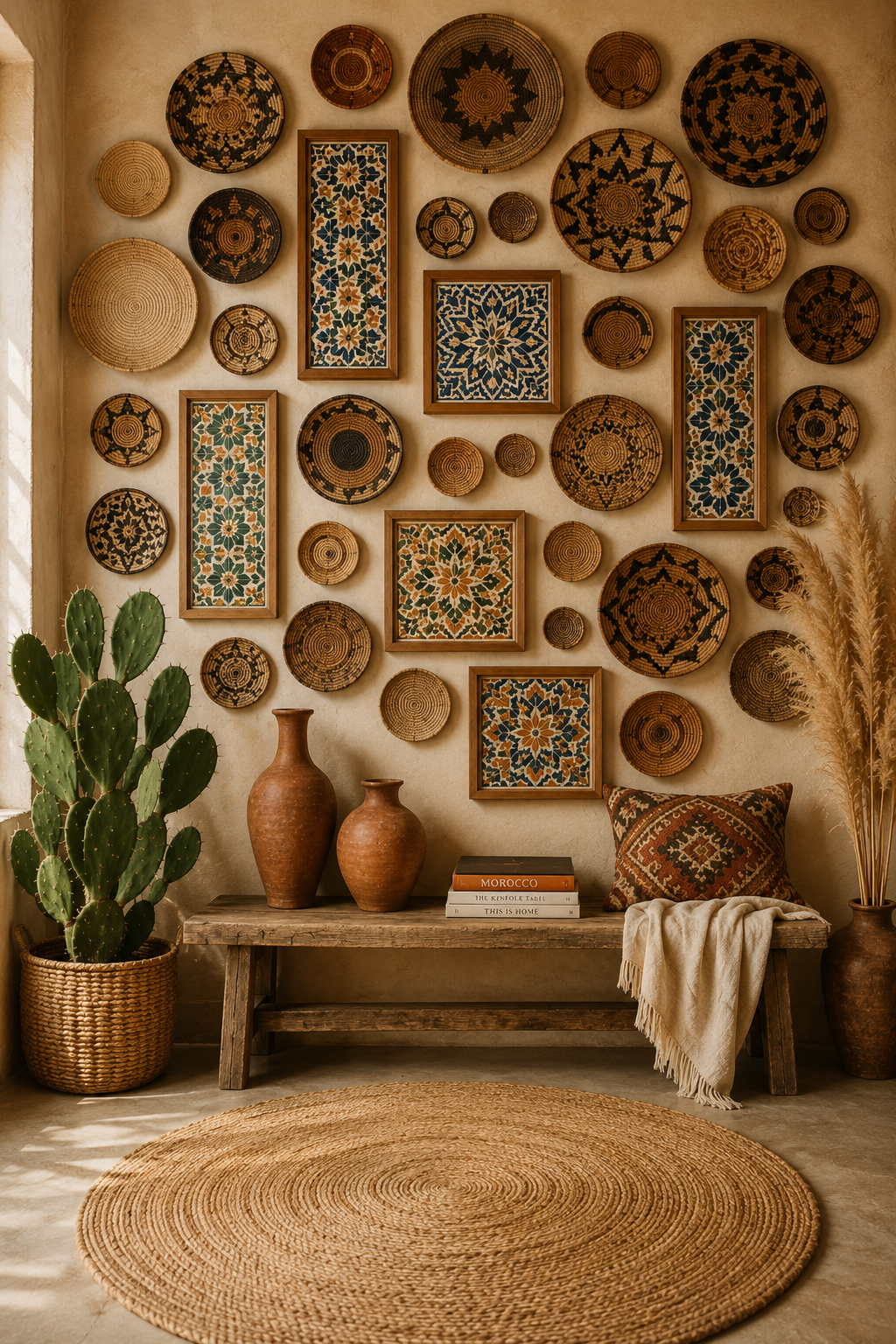
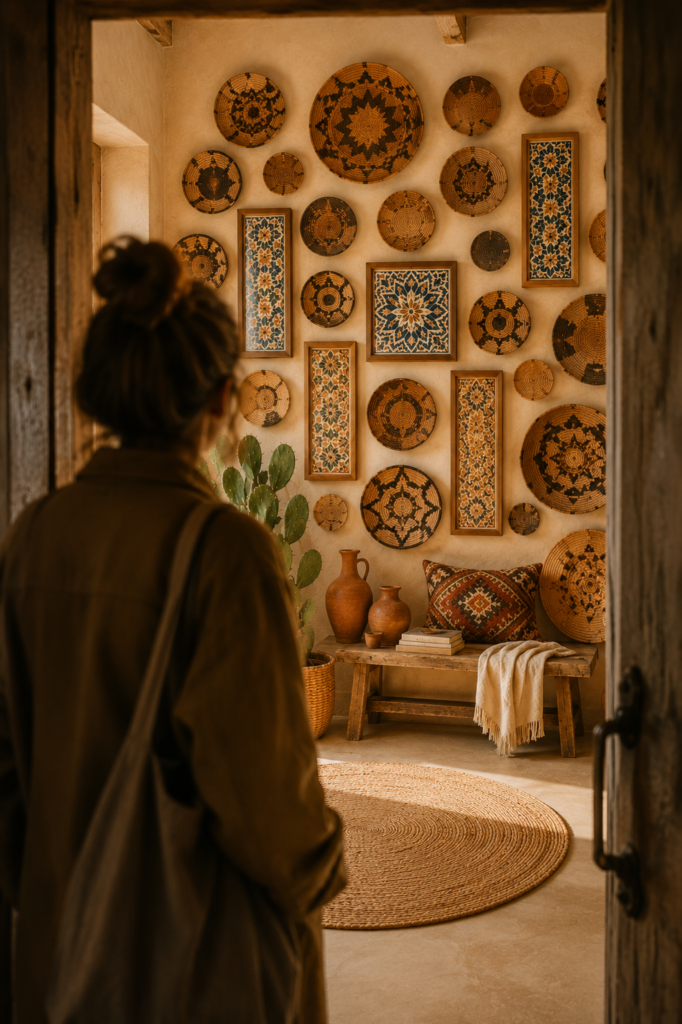
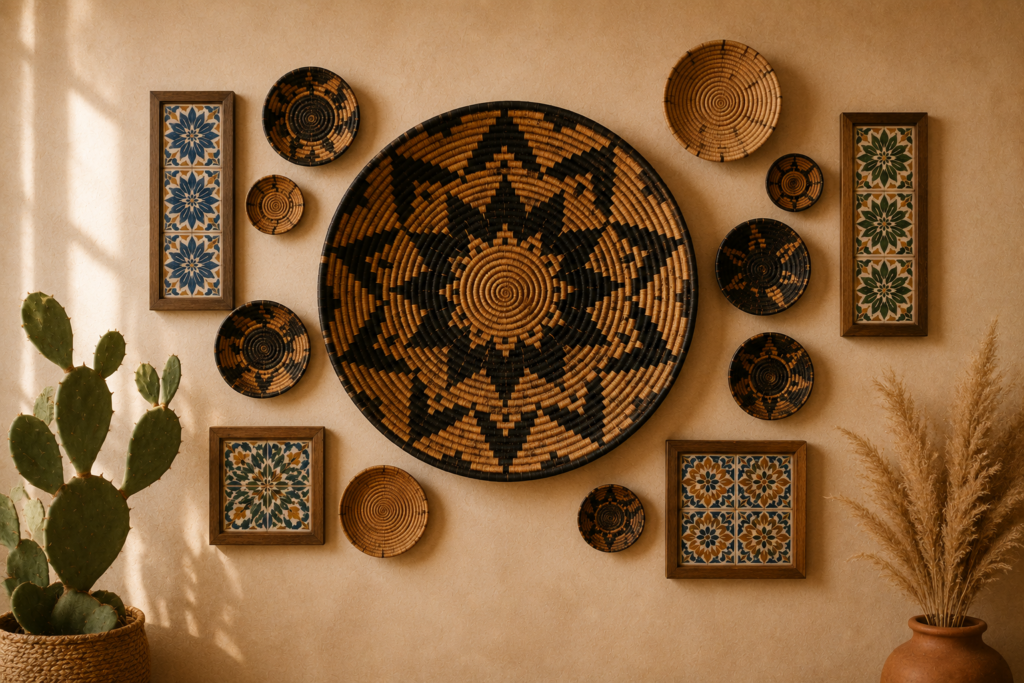
I saw it in a friend’s apartment — a rental, of all things, in a building that was nothing special from the outside. We walked in for dinner and I stopped in the hallway before I even took my coat off. Covering the entire wall in front of me: a constellation of woven baskets in every conceivable size, interspersed with framed tile panels in reclaimed wood — cobalt blue, terracotta, forest green, gold. Below it all, a simple wooden bench with two terracotta vessels, a kilim cushion, a cream throw draped casually over one end. A large prickly pear cactus in the corner. Dried pampas grass rising softly beside it.
I stood there for a full minute before I said anything.
Then I said: how long did this take you?
She laughed. About two years, she said. I started with one basket.
That answer changed how I think about decorating entirely. The wall did not happen in a single inspired afternoon. It grew. One basket became three, three became seven, the tile panels arrived from an Etsy shop in Morocco and everything clicked into place around them. The floor elements came last. And one evening in the golden light she stood back and realized she had made something that was entirely, unmistakably hers.
This post is built on that wall and that answer. Twenty-five ideas for creating a boho gallery wall that feels collected rather than decorated — organized by element, grounded in real sourcing and real prices, and honest about the fact that the best version of your wall is the one you build slowly, imperfectly, and with genuine love for the things you choose to put on it.
Before the Ideas: Why Boho Gallery Walls Work
Most people approach a gallery wall as a design problem. Which pieces? What arrangement? How much spacing?
The walls that stop people in their tracks were not approached that way. They were approached as a collection problem. Which things do I genuinely love? Where do they come from? What do they say about the life I am living?
Understanding the design principles behind a beautiful boho wall helps you make better instinctive decisions — so here they are, briefly and honestly.
Organic abundance over cautious minimalism. The most common mistake is hanging three pieces and stopping. The magic usually begins around piece seven or eight, when the wall starts to feel like a collection rather than a decoration. Give yourself permission to fill the wall. It will not feel like too much. It will feel like enough.
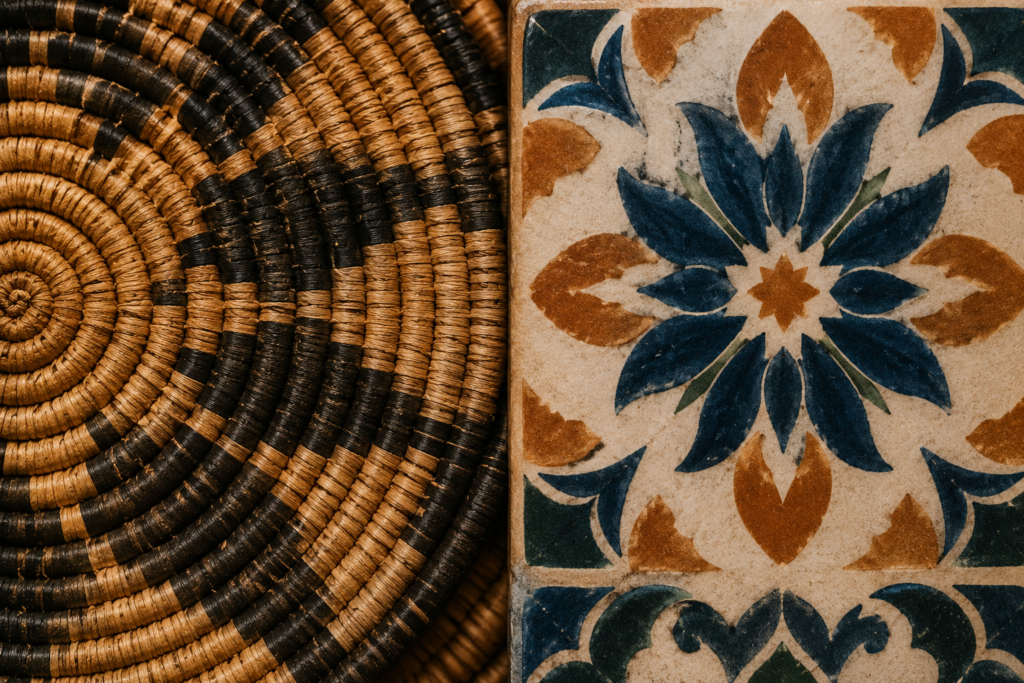
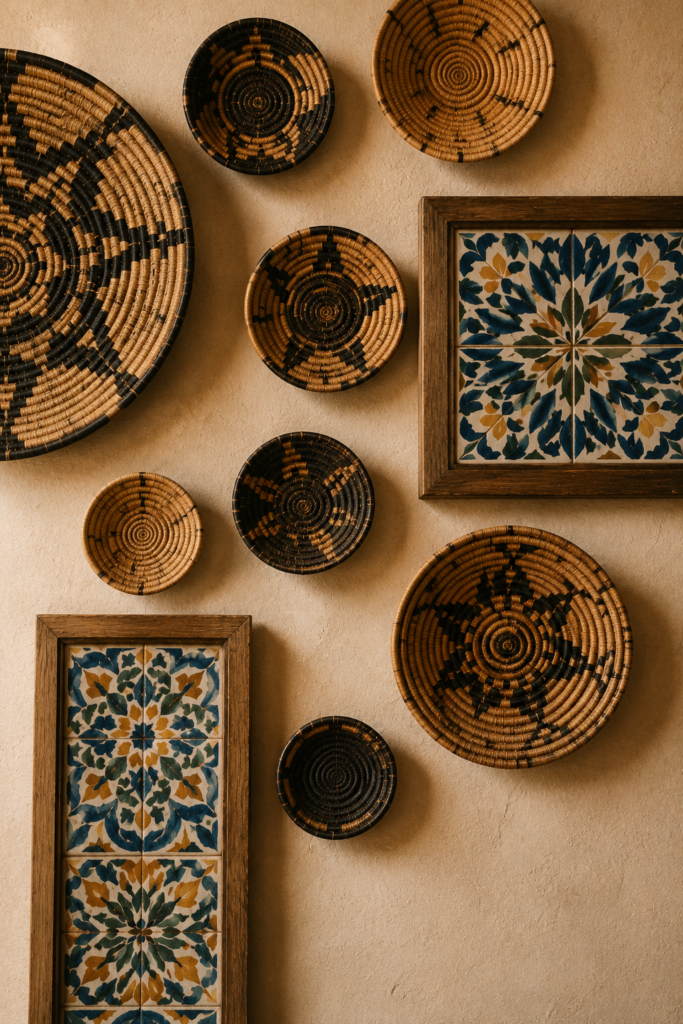
Texture contrast is everything. Woven baskets and painted tiles work together because they are opposites. The baskets are three-dimensional, rough-textured, natural, earthy. The tiles are flat, geometric, colorful, precise. Each makes the other more interesting. When everything on a wall shares the same texture, the eye gets bored and moves on. When textures contrast, the eye keeps finding new things.
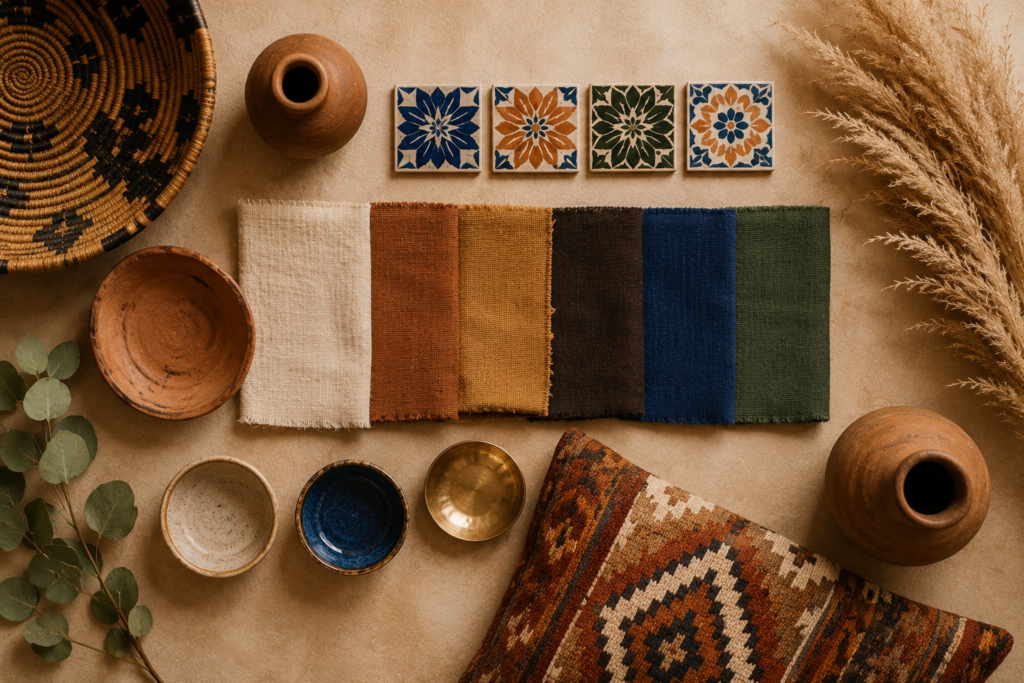
Color cohesion within variety. Look at the image that inspired this post carefully. Despite the enormous number of pieces, the overall palette is controlled — warm terracotta, honey brown, dark espresso, cobalt blue, forest green. All warm. Nothing cold. Nothing neon. The individual pieces vary wildly but the palette holds everything together. Decide on your palette before you start buying and let it guide every choice.
Scale rhythm. Large, medium, small, small, medium, large. The eye moves across a wall in rhythm and scale variation creates that rhythm. When every piece is the same size the rhythm flatlines. Learn to use large pieces as anchors, medium pieces as the body of the arrangement, and small pieces as punctuation.
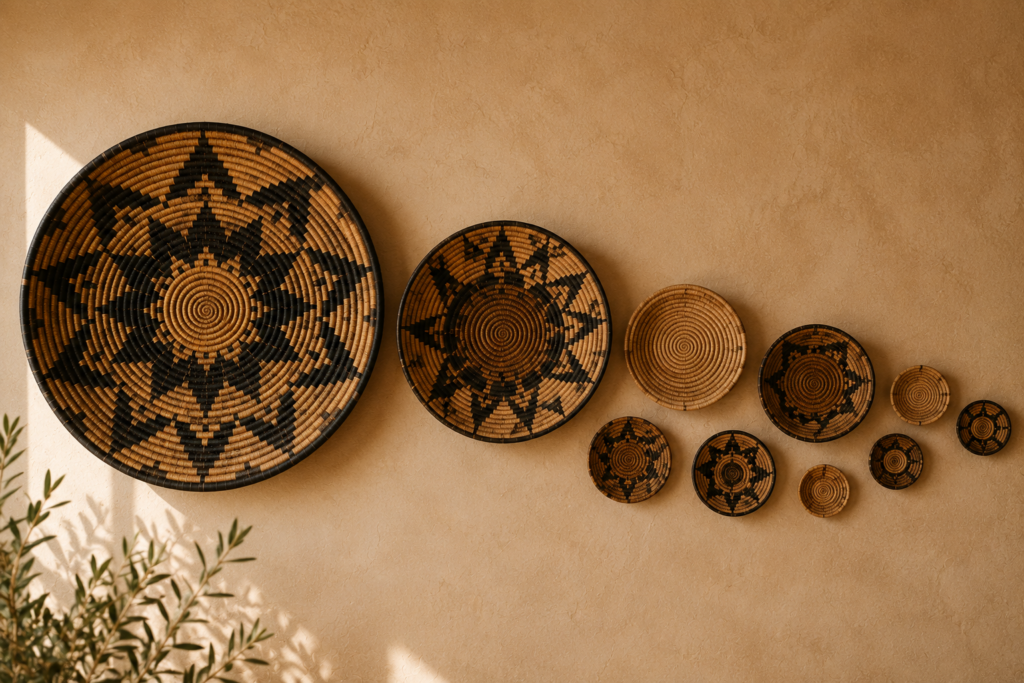
Intentional imperfection. Nothing on a beautiful boho gallery wall is perfectly aligned. The pieces are not on a grid. The spacing is not uniform. This is not carelessness — it is the specific quality that makes an arrangement feel collected rather than installed. And it is the most liberating design principle of all, because it means you genuinely cannot get this wrong. You can only get it more yourself.
The Baskets — Ideas 1 through 8
1. The Large Statement Basket — Your Anchor Piece
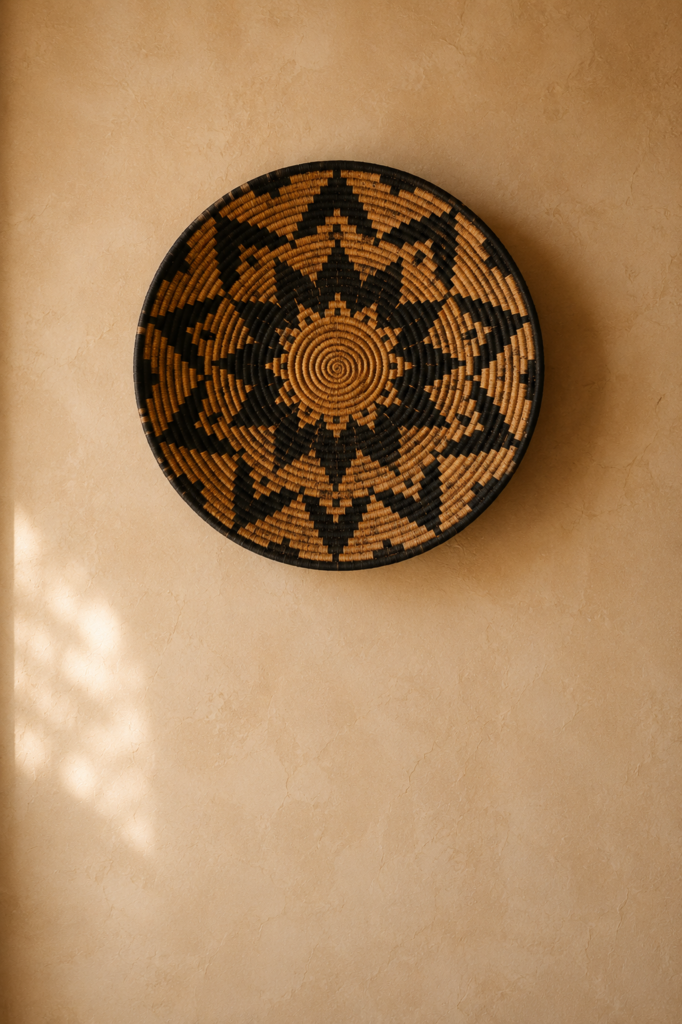
Every great boho wall starts with one piece that everything else orbits. In the image that inspired this post, that piece is the large black and natural woven basket in the upper center — bold, graphic, impossible to ignore from across the room. Before you buy anything else, find your anchor.
What to look for: hand-woven rather than machine-made (look for slight irregularity in the weave), a bold pattern that reads clearly from three meters away, a diameter of at least 50cm. The scale matters more than anything else. A piece this size requires confidence, and that confidence is exactly what sets the tone for everything that comes after it.
Where to find it: Etsy African basket sellers are the best single source — search “Rwandan peace basket large” or “Ghana woven wall basket” and filter by handmade. World Market and Terrain by Anthropologie carry curated selections. But the real secret, the one I wish someone had told me earlier, is estate sales and charity shops. Genuine handmade baskets from the 1970s and 80s turn up regularly for almost nothing — weathered, slightly imperfect, and carrying forty years of character that no new basket can replicate.
Price range: $15–$200 depending on origin and size.
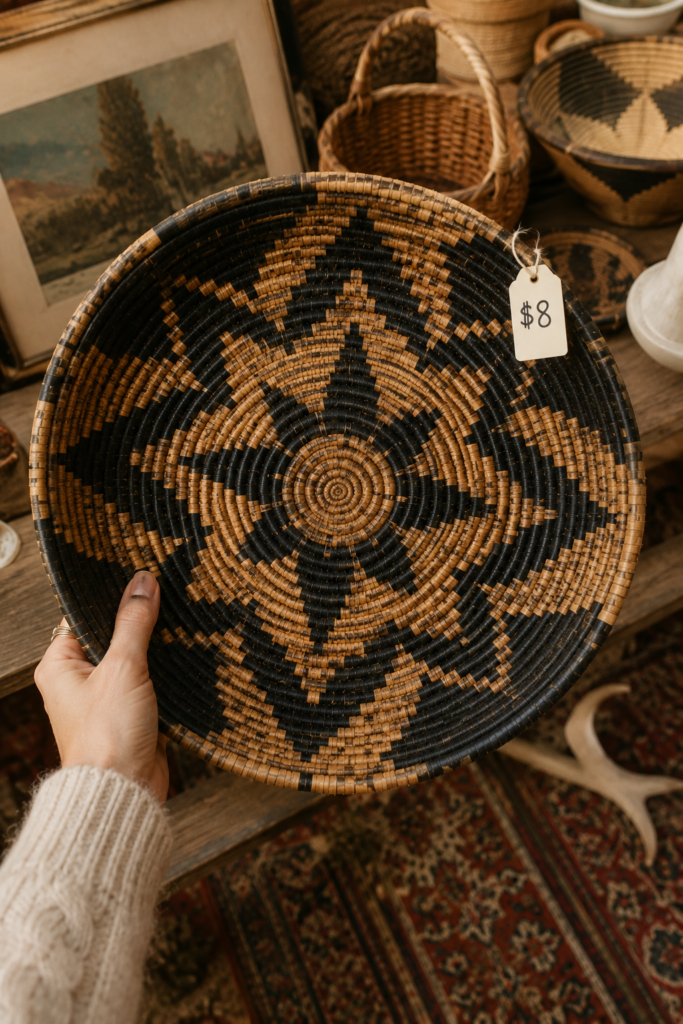
The first large basket I bought cost $8 at an estate sale. I almost did not buy it because the pattern felt bold and I was not sure I was bold enough for it. I bought it anyway. It is still the piece everyone asks about.
2. The Odd-Number Cluster
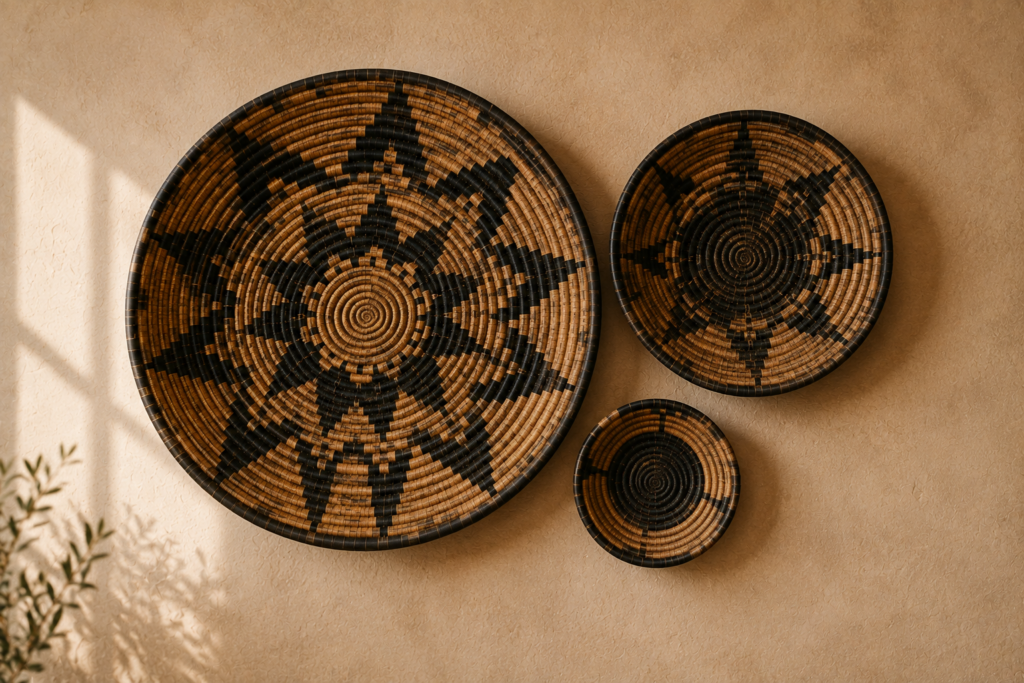
Three baskets. Five baskets. Seven baskets. Never four, never six. The odd number rule in design exists because odd groupings feel organic — the eye cannot find a center and so keeps moving, which is exactly what you want.
For a three-basket cluster: one large (50cm+), one medium (30–35cm), one small (15–20cm). Arrange them so their edges almost touch — this reads as intentional grouping rather than random scattering. The tighter the cluster the more confident it looks.
3. The Tonal Basket Collection
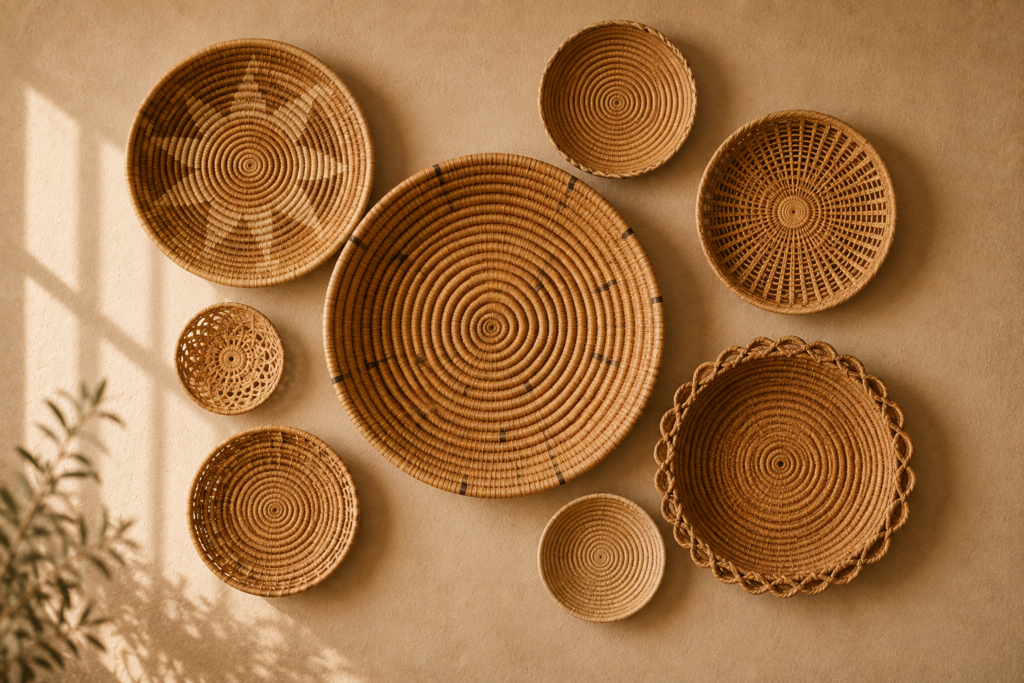
All baskets in the same color family — all honey and natural, or all dark espresso and black, or all bleached cream and white. The monochrome approach lets the texture and pattern variation carry all the interest without color competition. The result is sophisticated and surprisingly bold, because the eye is drawn entirely into the weave variations rather than the color contrasts. This approach works beautifully in minimal or Scandi-boho interiors where a full mixed-palette arrangement would feel too busy.
4. The Mixed Origin Basket Wall
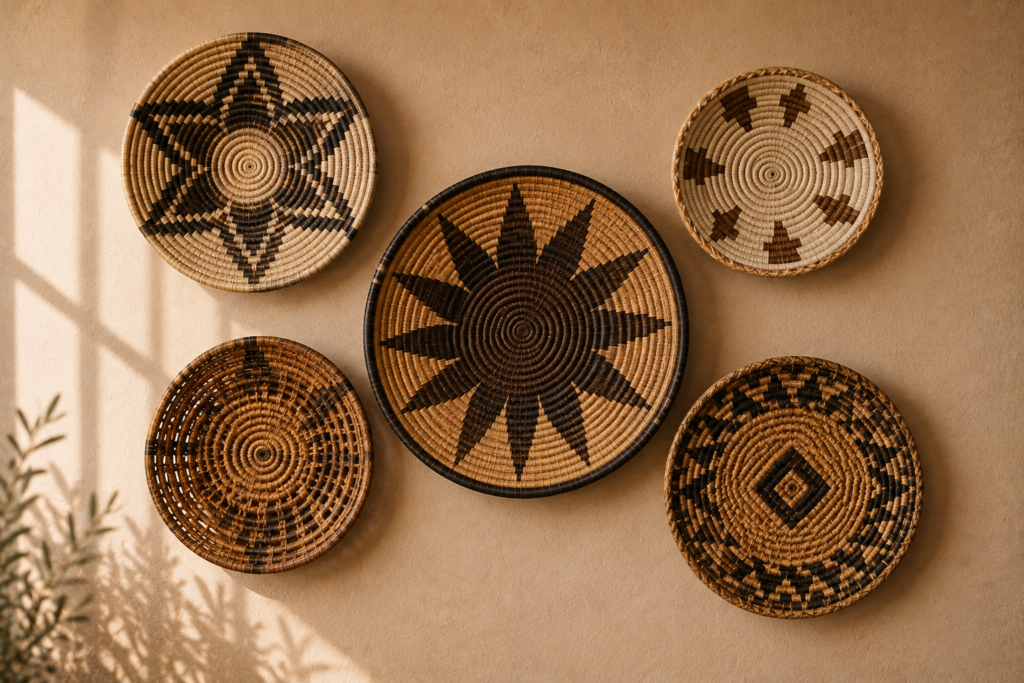
African peace baskets alongside Moroccan bread baskets alongside Southwestern coiled baskets alongside Southeast Asian rattan pieces. The different weaving traditions create genuine visual variety — different pattern languages, different textures, different visual personalities that have never met before and look extraordinary together.
Do the research. Know where each piece comes from. Write it down somewhere, even if no one else ever sees it. The knowing changes how the wall feels — to you, and somehow, mysteriously, to everyone who looks at it.
5. The Floor Basket Moment
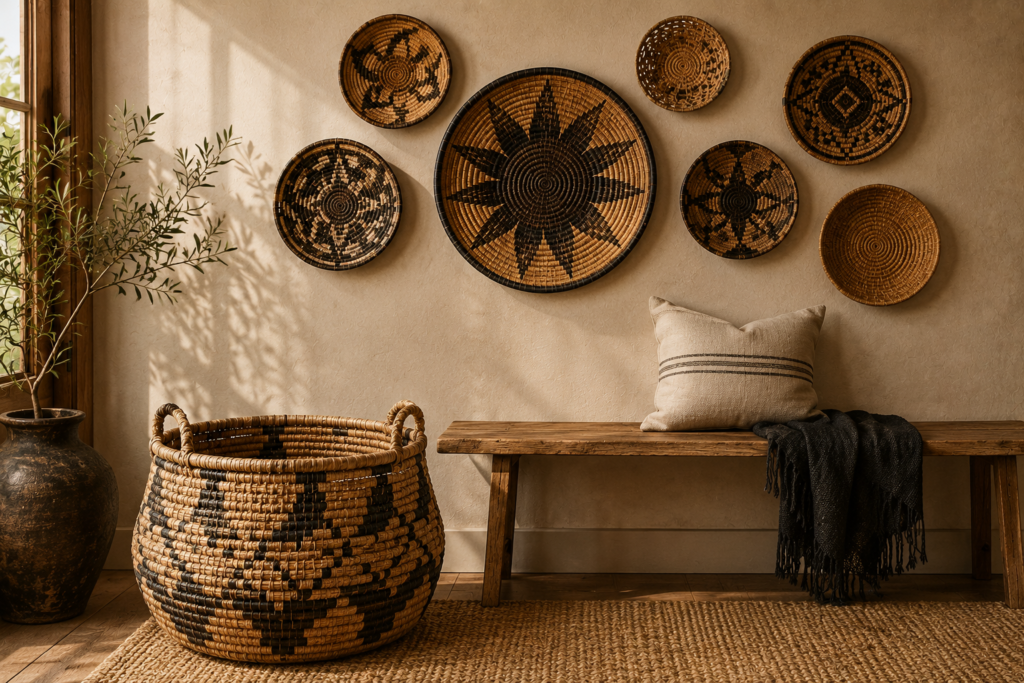
Not everything has to be on the wall. In the image that inspired this post, a large woven basket sits on the floor beside the cactus — completing the arrangement from ground level and preventing the wall display from feeling like it is floating above the room rather than belonging to it.
A large floor basket at the base of a gallery wall grounds the entire composition. Fill it with throws, with magazines, with nothing. The basket itself is enough.
6. The Basket and Plate Alternating Rhythm
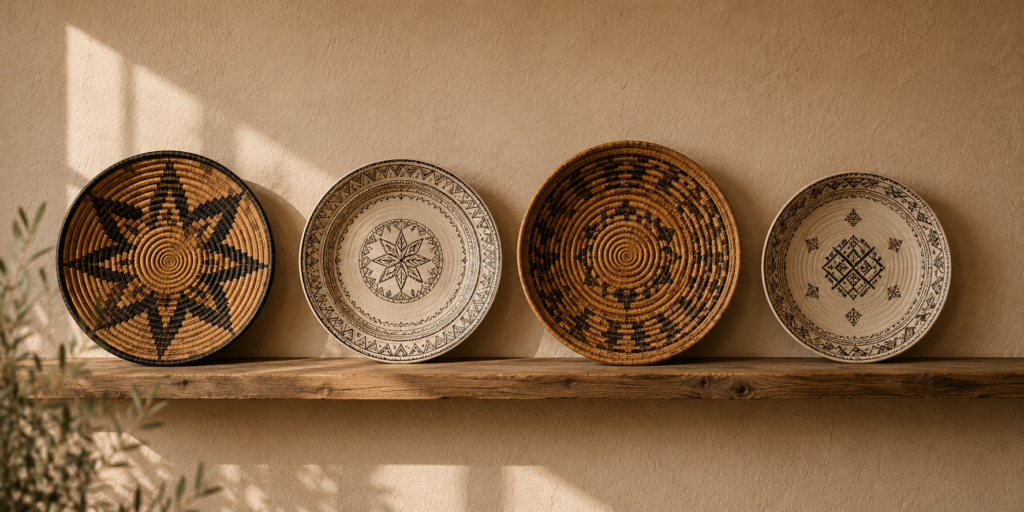
Alternate round woven baskets with round decorative ceramic or wooden plates — basket, plate, basket, plate — in a horizontal or diagonal line. The contrast between the woven texture and the painted or carved surface creates a beautiful, almost musical rhythm. Keep the diameters similar so the alternation reads clearly as a deliberate choice rather than an accident.
7. The Small Basket Constellation
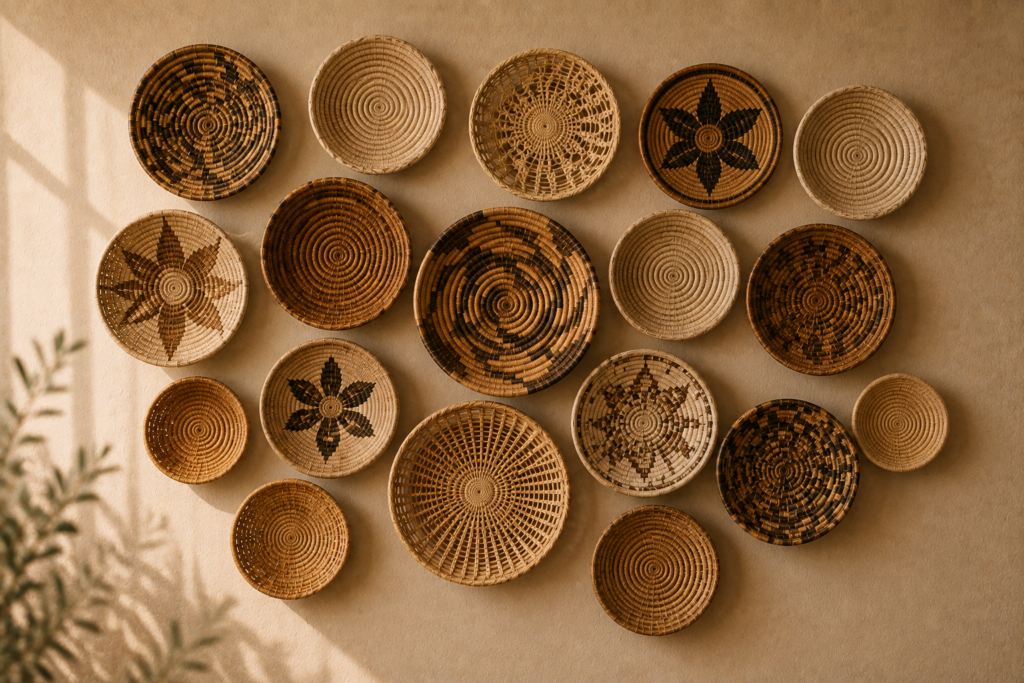
A cluster of ten to fifteen small baskets (10–25cm each) grouped tightly in one corner or section of the wall — a dense constellation of texture and pattern. This approach works as a statement section within a larger gallery arrangement or as a standalone feature above a small shelf or bedside table. The density of small pieces creates an effect that is greater than the sum of its parts.
8. The Full Wall Installation
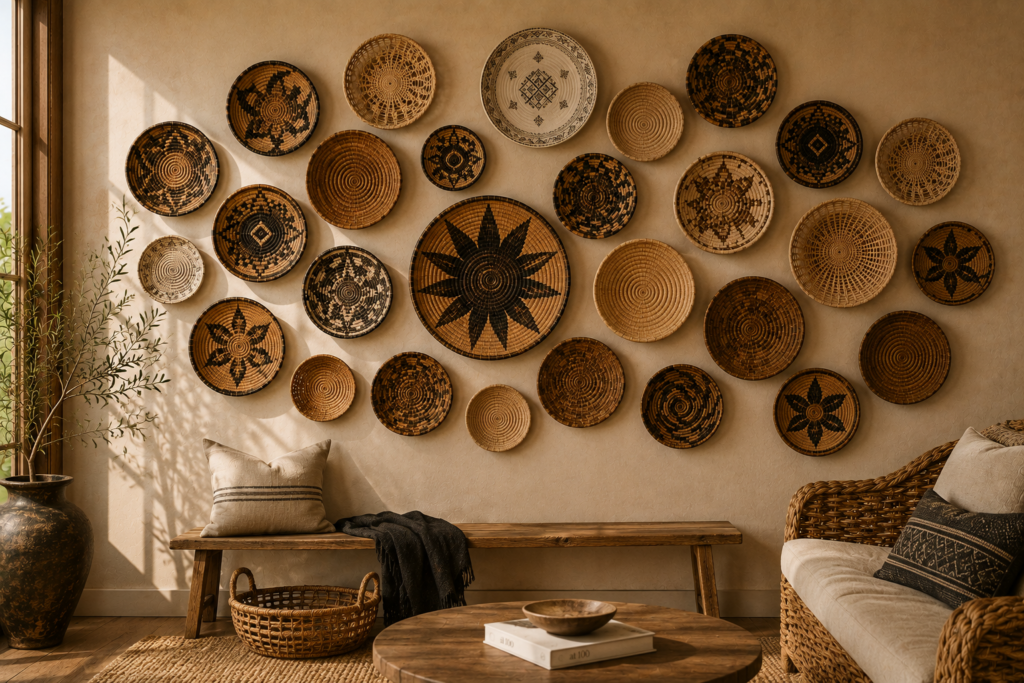
The approach in the hero image — twenty or more baskets covering most of a wall, interspersed with framed tile panels, filling the space with organized abundance. This is the commitment version. It requires an afternoon, a lot of paper, and genuine trust in the process.
How to plan it without losing your mind: cut paper circles and rectangles in the sizes of your baskets and frames, label each template with the piece it represents, tape them to the wall with painter’s tape, stand back, move them around, argue with yourself, move them again, sleep on it, come back the next morning with fresh eyes, make tiny adjustments. Then and only then start making holes.
The paper template method is not optional for a large installation. It is the thing that saves you from filling your wall with the wrong holes.
The Framed Tile Panels — Ideas 9 through 14
9. The Three-Tile Vertical Panel
The signature element of the image that inspired this post — three hand-painted decorative tiles arranged vertically in a reclaimed wood frame. The tiles in the image appear to be Moroccan or Talavera-style with bold geometric and floral patterns in cobalt, terracotta, and forest green. The reclaimed wood frame warms the color of the tiles and gives each panel the slightly rough, found-object quality that makes it feel discovered rather than purchased.
DIY version: buy three individual decorative tiles from an Etsy seller ($3–$8 each), find a reclaimed wood frame at a thrift store or build a simple shadow box from pallet wood, mount the tiles with construction adhesive, allow 24 hours to cure, hang.
Total cost: $15–$40 for a piece that looks like it cost $150. This is one of the best value-to-impact ratios in all of boho home decor.
10. The Four-Tile Square Panel
Four tiles in a two-by-two arrangement — mixing two complementary pattern types for visual richness. The square format creates a compact, dense piece with enormous visual weight for its size. Works especially well tucked between larger baskets where a tall vertical panel would not fit.
11. The Six-Tile Horizontal Panel
A wide horizontal panel in a reclaimed frame — three tiles across, two rows deep. The horizontal format provides essential variety in a gallery arrangement where most other pieces are vertical or round. Every arrangement needs at least one strong horizontal element to prevent the eye from moving only up and down.
12. The Single Statement Tile
One extraordinary hand-painted tile, mounted and framed like a painting — wide mat, substantial frame, plenty of breathing room around the tile itself. The solo presentation works when the tile is genuinely beautiful enough to carry it. Authentic hand-painted Moroccan ceramic tiles from specialist importers have exactly this quality. They are individual works of art that happen to be ceramic.
13. The DIY Tile Panel Workshop
Step 1: Source your tiles. Etsy sellers in Morocco, Spain, Mexico, and Portugal offer hand-painted tiles at $3–$12 each and ship internationally. Order a variety pack if available — having more tiles than you need lets you audition different combinations before committing.
Step 2: Find your frame. Thrift stores, Habitat for Humanity ReStores, or pallet wood cut and assembled into a simple shadow box. The frame does not need to be perfect. It needs to look like it has lived a little.
Step 3: Arrange the tiles in the frame before gluing. Live with the arrangement for a day. You will almost certainly move at least one tile.
Step 4: Mount with construction adhesive. Allow 24 hours to cure before handling.
Step 5: Optional — fill the gaps between tiles with grey or terracotta grout for a more finished look. Dark grey grout reads more authentic than white.
Step 6: Sand and oil the wood frame if needed. Add hanging wire to the back.
Total time: two hours plus curing time. Total cost: $20–$45. The result: something you made, which is always worth more than something you bought.
14. The Tile and Basket Integration
The specific technique visible throughout the hero image — framed tile panels and woven baskets hung in such close proximity that they read as a single arrangement rather than two separate things. The geometric precision of the painted tiles against the organic texture of the woven baskets creates a contrast that makes both elements more interesting.
The key to making this work: keep the gaps between a basket edge and a tile frame edge at 5–8cm. Close enough to read as intentional. Not so close that the pieces compete.
Natural Elements — Ideas 15 through 19
15. The Dried Pampas Grass Corner
The dried pampas grass in the right corner of the hero image is doing something the other pieces cannot do — it adds soft vertical height and organic movement to what would otherwise be a flat rectangular arrangement. Placed in a corner beside the wall display rather than on the wall itself, it draws the eye upward and outward and makes the entire vignette feel larger than it is.
One large bundle in a tall terracotta urn or a woven floor basket. No water needed. Dried pampas lasts for years and gets more beautiful as it ages, the fronds softening from cream to warm ivory.
I have had the same pampas grass bundle for four years. Every year I think I should replace it. Every year I decide it looks better than anything new I could find.
16. The Prickly Pear as Anchor
The large prickly pear cactus in the left corner of the hero image is doing more design work than it might initially appear. Its verticality and visual mass ground the left side of the entire wall arrangement. Its living, natural quality contrasts with everything woven and painted above and beside it. And its terracotta pot connects it to the warm sandy palette of the wall in the most direct possible way.
A large cactus or a tall olive tree in a terracotta or woven planter is the floor-level element that transforms a decorated wall into a complete room. Without it, the arrangement floats. With it, the arrangement belongs.
17. The Pressed Botanical Frames
Simple pressed leaves and flowers in mismatched wooden frames, tucked into the gallery arrangement between baskets and tile panels. The botanical element adds an organic softness to what could otherwise feel quite graphic and structured. And they are among the cheapest things you can add to any arrangement — press your own between the pages of a heavy book for two weeks, frame them in charity shop finds, and you have wall art that cost almost nothing and looks completely intentional.
18. The Air Plant Wall Garden
A small collection of tillandsia (air plants) mounted on cork circles or small pieces of driftwood, hung as part of the gallery arrangement. They require no soil, no watering beyond a misting twice a week, and they add the one thing dried and woven elements cannot — actual living growth. The surprise of finding something alive within a wall of baskets and tiles is one of the small pleasures of a well-composed boho arrangement.
19. The Driftwood Horizontal Installation
A long piece of weathered driftwood hung horizontally, with small baskets, leather cord, and air plants hanging from it at different lengths. Creates a wide horizontal element with a natural, beach-combed quality that balances arrangements that have become too vertical in their composition. Find your driftwood at the beach, along riverbanks, or through Etsy sellers who collect and ship it. The best pieces look like they were found, because they were.
The Bench and Styling Foundation — Ideas 20 through 22
20. The Bench Moment
The wooden bench in the hero image is doing everything right. It is simple — reclaimed wood, no cushion, no paint. It is the right height. And it is styled with genuine restraint. Two vessels, a book stack, a cushion, a throw. Nothing more. The bench gives the wall art a landing place and transforms a flat wall into a complete room vignette — something you walk toward rather than simply look at.
The right bench looks like it has a history. An antique market find, a Facebook Marketplace discovery, a piece of reclaimed timber assembled by someone who understood that the beauty is in the wood and not the finish. The bench should look like it belonged somewhere else first.
21. The Pottery Composition
Two or three vessels of dramatically different heights — not slightly different, dramatically different. In the hero image: one tall narrow terracotta urn, one shorter rounder vessel. The space between them is as important as the vessels themselves. Do not crowd them.
Stack a book beneath the shorter vessel to bring it slightly up in the composition. Place a small ceramic bowl or a smooth stone on top of the book stack. These small adjustments take thirty seconds and make the difference between a shelf that looks styled and a shelf that looks arranged.
22. The Throw and Cushion Styling
The cream linen throw in the hero image is not folded. It is draped — one end over the bench back, the rest pooling softly on the seat and touching the floor. This is not carelessness. It is a specific and entirely learnable styling decision that makes furniture look inhabited rather than staged.
The kilim cushion beside it references the colors in the tile panels above — connecting the floor level of the arrangement to the wall level, making the whole vignette read as a single composed thought rather than a collection of separate decisions.
The Wall Foundation — Ideas 23 through 25
23. The Limewash Wall
The sandy, subtly textured wall in the hero image is not a neutral backdrop. It is an active participant in the arrangement. A smooth bright white wall would kill this display — the baskets and tiles would look like they were hung on a hospital wall. The warm, slightly imperfect limewash surface gives every piece a backdrop that feels ancient and alive, like the walls of a riad or a farmhouse that has been absorbing sunlight for a hundred years.
How to get this look: Portola Paints Roman Clay and Romabio Classico Limewash are the two most accessible options in the US. LICK makes an excellent UK equivalent. Applied in two thin coats with a wide brush, the second coat partially wiped back while still wet to create the characteristic tonal variation. One weekend project. Cost: $45–$80 for a standard room wall.
This is the single investment that will do more for your boho wall than any individual piece you could hang on it.
24. The Jute Round Rug
The round jute rug at the base of the hero image is doing something quiet but essential — it defines the zone. It tells the eye where the vignette begins and ends. It grounds the bench and the cactus and the floor basket in a single contained space. And its natural fiber texture references the woven baskets above it, connecting the floor to the wall in one material language.
Round rather than rectangular: the softened edge prevents the arrangement from feeling too formal or too contained. The room breathes differently with a round rug under a gallery wall than it does with a rectangular one.
25. The Arrangement That Is Never Finished
The final idea is not a product. It is a practice.
A boho gallery wall is never finished. This is not a problem — it is the entire point.
The basket you find at the market next summer will go up. The tile panels you order after a trip to Lisbon will find their place. The small woven piece your friend brings back from her travels will slip into a gap you did not know needed filling until it was filled. An arrangement that is never finished is an arrangement that keeps growing with your life, and that is the most beautiful thing a wall can do.
Give yourself permission to start imperfectly. Hang three pieces. Live with them for a week. Add two more. Move one. Remove one. Add something different. The arrangement that feels right six months from now will be better than the one you could have planned today, because it will have been shaped by your actual life rather than your intentions.
The Complete Budget Breakdown
The Renter’s Boho Wall — Under $200
Zero permanent damage. Maximum impact.
| Item | Cost |
|---|---|
| Command strips (large, for lightweight baskets) | $18 |
| Three woven baskets (World Market or Amazon) | $55 |
| Two DIY framed tile panels | $35 |
| Small dried pampas bundle | $22 |
| Two terracotta pots (garden center) | $12 |
| Round jute rug (Amazon or IKEA) | $35 |
| One small terracotta vessel for styling | $15 |
| Total | $192 |
The Homeowner Weekend Project — $200–$600
One weekend, one wall, completely transformed.
| Item | Cost |
|---|---|
| Limewash paint (one feature wall) | $55 |
| Seven mixed baskets (Etsy artisan sellers) | $160 |
| Three ready-made framed tile panels | $110 |
| One large macramé hanging | $65 |
| Kilim cushion | $55 |
| Vintage terracotta vessels (two) | $60 |
| Large prickly pear cactus | $45 |
| Round jute rug | $40 |
| Total | $590 |
The Full Investment Wall — $600–$2,000
The wall that guests photograph without asking permission.
| Item | Cost |
|---|---|
| Professional limewash plaster (full wall) | $350 |
| Fifteen curated African and Moroccan baskets | $600 |
| Six custom framed authentic tile panels | $420 |
| Genuine vintage kilim cushion | $150 |
| Handmade pottery vessels (three) | $180 |
| Large specimen prickly pear cactus | $120 |
| Dried botanicals and pampas grass | $80 |
| Reclaimed wood bench | $200 |
| Total | $2,100 |
Where to Shop — The Honest Source Guide
For woven baskets: Etsy is the best single source — search “African basket wall art,” “Rwandan peace basket,” “Moroccan bread basket wall,” or “Ghana woven basket.” Filter by handmade and read reviews carefully. World Market and Terrain carry accessible curated selections. Estate sales and charity shops are the source of the best pieces at the lowest prices.
For decorative tiles and framed panels: Etsy sellers in Morocco, Spain, Portugal, and Mexico ship internationally and offer hand-painted tiles at prices that make the DIY version genuinely compelling. Search “Moroccan decorative tile,” “Talavera tile set,” or “hand-painted ceramic tile wall art.” Anthropologie carries beautiful ready-made versions at a higher price point.
For macramé and textile wall art: Etsy handmade macramé makers for the most distinctive pieces. Urban Outfitters and Free People Home for accessible mid-range options. West Elm for a more polished version.
For ceramics and pottery: HomeGoods and TJ Maxx for affordable vessels that look far more expensive than they are. Anthropologie for hand-painted plates and distinctive ceramic pieces. Local pottery studios and markets for pieces with genuine maker provenance.
For natural elements: Etsy dried botanical sellers for pampas grass bundles. Local florists for eucalyptus and seasonal botanicals. IKEA for affordable terracotta pots that are honestly some of the best you can buy at any price. Local garden centers for large cacti — always buy in person so you can choose the specific plant rather than receiving a surprise.
For the wall: Portola Paints (US), Romabio (US and EU), LICK (UK) for limewash paint. All available online with detailed application tutorials on their websites.
The Wall That Becomes Yours
Here is what I want you to take from this post more than any specific idea or sourcing tip or budget breakdown.
The wall that stopped me in my friend’s hallway three years ago was not impressive because of what was on it. It was impressive because of who it belonged to. Every basket came from somewhere. Every tile panel had a story — ordered from a seller in Fez after she spent a sleepless night down a Moroccan craft rabbit hole at 2am, arrived in bubble wrap and were even better than the photos. The bench was her grandmother’s. The kilim cushion was from a market she almost did not go to.
The wall was not decorated. It was collected. Over time, with love, from a life that paid attention to beautiful things and found them places to live.
That is what this post is really about.
Not the baskets. Not the tile panels. Not the limewash paint or the jute rug or the prickly pear in the corner.
The practice of noticing the things that move you. The courage to hang them on your walls without waiting until you have the perfect wall or the perfect arrangement or enough money for the version you saw on Pinterest. The patience to let the wall become what it wants to be, slowly, imperfectly, one genuine find at a time.
Start with one basket.
The wall will tell you what comes next.
Which element are you starting with? Tell us in the comments — and please share a photo when your wall is done. Nothing makes us happier than seeing where these ideas land in real people’s real homes.