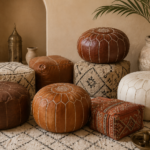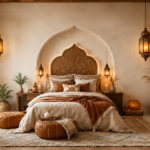

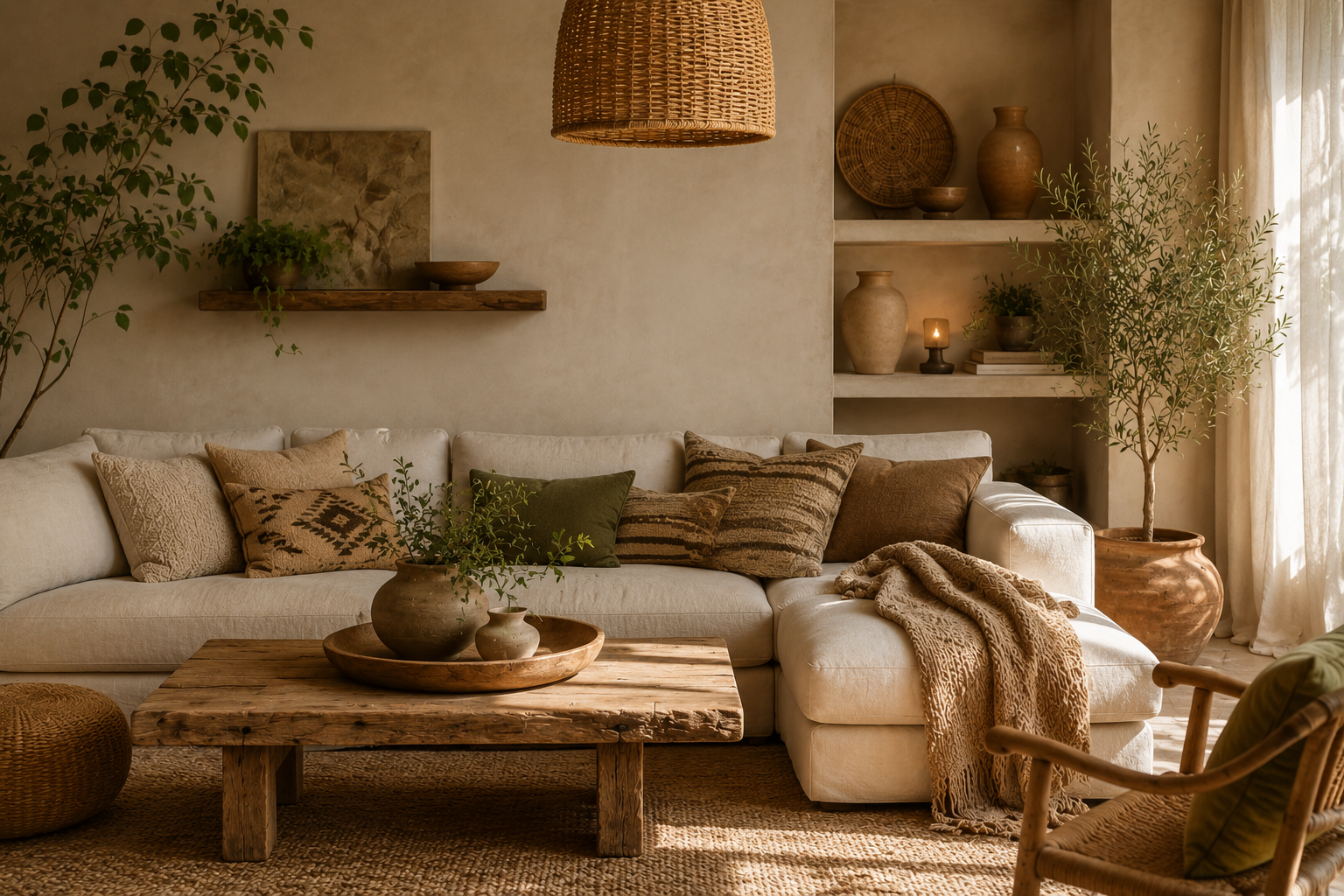
There’s a reason so many of us are drawn to interiors that feel grounded, warm, and unhurried. After years of bright white walls, chrome finishes, and maximalist clutter, something in us is collectively exhaling and reaching for terracotta pots, linen cushions, and the smell of wood and dried herbs. Earthy home decor isn’t a trend that arrived and will leave again. It’s a return to something older and more instinctive — the idea that our homes should feel like a refuge, not a showroom.
Whether you’re starting from scratch or looking to bring more calm into a space that already exists, these 15 ideas will give you a practical, honest guide to creating a home that feels as good as it looks.
1. Start with an earthy colour palette
Before you move a single piece of furniture, look at your walls. Colour is the fastest and most impactful way to shift the entire feeling of a room.
Earthy palettes pull from nature’s quietest moments — the warm ochre of dried grass, the soft clay of a riverbank, the dusty green of sage growing in a Mediterranean hillside. Think terracotta, warm sand, mushroom brown, olive, and stone. These are colours that absorb light rather than bounce it, which is exactly why they feel so calming.
Start with one wall if you’re nervous. A deep clay tone on a single feature wall behind a sofa or bed changes the entire atmosphere of a room without committing to a full repaint. Brands like Farrow & Ball, Little Greene, and Earthborn all offer beautiful earthy ranges that lean into natural pigments rather than synthetic brights.
Avoid bright whites as your base — they fight with earthy accessories and make terracotta look garish. Instead, reach for off-whites, warm creams, and limewash finishes that have texture and depth.
2. Bring in natural textiles
Fabric choices make or break an earthy interior. Synthetic fabrics — polyester cushions, acrylic throws, plastic-backed rugs — have a flatness and sheen that jars against natural materials, even if the colour is right.
Natural textiles to look for: linen (in all its rumpled, beautiful imperfection), cotton canvas, jute, hemp, and wool. These materials have texture, variation, and a tactile quality that you can feel as well as see. A linen cushion cover that’s slightly wrinkled isn’t a flaw — it’s what makes it feel real.
For bedding, undyed or stone-washed linen is the gold standard of earthy bedrooms. It looks effortless, feels incredible, and gets better with every wash. Pair with a chunky knit throw in cream or warm oatmeal, and you’ve done 80% of the work in that room already.
For living spaces, layered rugs work brilliantly — a flat-woven cotton rug underneath a smaller, textured jute or wool piece creates depth and warmth underfoot without looking overdone.
3. Use wood in every room — imperfect wood
There is no earthy home without wood. But the kind of wood matters enormously.
Highly polished, dark-stained, or very uniform wood has a formality that works against the relaxed naturalism you’re going for. What earthy interiors call for is wood with character — visible grain, knots, variation in tone, rough-hewn edges, and a finish that’s matte or oiled rather than lacquered to a shine.
Reclaimed wood is the holy grail here. Old scaffold boards, salvaged oak beams, or furniture made from reclaimed pine carry decades of patina that no new piece can replicate. Reclaimed wood shelving, a solid wood dining table, or even a simple wooden chopping board left out on a worktop — these things ground a room instantly.
If new furniture is what you’re buying, look for pieces made from solid wood (not MDF with a wood-effect veneer), and choose lighter tones — oak, ash, or pine — over very dark mahogany or walnut, which can feel heavy rather than earthy.
4. Layer in natural stone and clay
Stone and clay bring something wood can’t — a coolness, a weight, a sense of geological time. Even small amounts of these materials shift the energy of a room.
In kitchens and bathrooms, stone tiles are transformative. Travertine, slate, and limestone all work beautifully in earthy interiors, and they age in a way that only improves them. If full stone tiling is out of budget, stone-effect porcelain has come on enormously and offers a convincing alternative.
For accessories, look for handmade ceramics with visible throwing lines, uneven glazes, and earthy colours. A rough-textured ceramic vase, a handmade bowl on the kitchen counter, or a set of stoneware mugs add subtle but powerful texture to a space. The handmade quality — the slight imperfection — is what you’re after.
Clay render on walls is a growing trend in earthy interiors and for good reason. It gives walls a depth and texture that paint simply can’t replicate, and it actually regulates humidity in a room, making it a practical as well as beautiful choice.—
5. Fill your space with living plants — but choose wisely
Plants are non-negotiable in earthy interiors. But this isn’t about cramming every windowsill with houseplants and calling it done. It’s about choosing plants that feel like they belong in a natural environment, not a garden centre display.
The plants that work best in earthy interiors tend to be sculptural, unfussy, and a little wild-looking. Think:
Olive trees in large terracotta pots for living rooms with good light — they bring a Mediterranean, timeless quality.
Trailing pothos or ivy draped over shelving, softening hard edges and bringing life to vertical space.
Snake plants and sansevieria for corners that don’t get much light — upright, graphic, and remarkably low maintenance.
Dried botanicals alongside living plants. Dried pampas grass, eucalyptus, cotton stems, and seed heads bring texture and movement, last for months, and don’t need watering.
Herbs on the kitchen windowsill — rosemary, thyme, sage. They smell extraordinary, look beautiful, and actually get used.
The key is to let plants look a little natural rather than perfectly pruned. A trailing plant that’s been allowed to grow long, a terracotta pot with a bit of moss on it, a tree with asymmetric branches — these feel earthy. A perfectly symmetrical plant in a pristine white pot does not.—
6. Swap synthetic lighting for warm, layered light
The way a room is lit changes everything. Bright overhead lighting — especially cool white LED strips or halogen downlighters — kills the atmosphere of an earthy interior stone dead. You walk into a space that has beautiful terracotta walls and handmade ceramics and warm linen, and then a ceiling full of clinical white light makes it feel like a dentist’s waiting room.
Earthy interiors need warm, layered light. This means:
Warm bulbs — always 2700K or lower. This is the warm amber end of the spectrum, close to candlelight. It makes skin glow, wood sing, and textiles look rich.
Multiple light sources at different heights. A floor lamp in the corner, table lamps on side tables, pendant lighting over a dining table, candles on a coffee table. Layers of light at different levels create intimacy and warmth that a single ceiling light never can.
Natural materials in your light fittings. Rattan pendants, woven lampshades, ceramic base lamps, wooden wall sconces. The fittings themselves become part of the earthy texture of the room.
Candles. Obviously. A room with candles burning looks like a completely different room. Beeswax candles in particular have the most beautiful warm, golden light of anything you can buy.
7. Choose furniture with a slow, handmade quality
Mass-produced furniture — the kind that arrives flat-packed and is made of composite boards — has a uniformity and lightness that works against earthy interiors. Even if it’s the right colour, there’s a disposability to it that undermines the whole feeling you’re trying to create.
Earthy interiors call for furniture that looks and feels like it took time to make. This doesn’t mean expensive — it means considered.
Secondhand and antique furniture is one of the best routes here. A mid-century oak sideboard, a worn leather armchair, a pine farmhouse table with decades of scratches — these pieces have weight and authenticity that no new piece can replicate. Charity shops, salvage yards, Facebook Marketplace, and eBay are your best friends.
If you’re buying new, look for makers who work with solid materials and traditional joinery. Smaller independent furniture makers often produce pieces that are genuinely built to last and have a craft quality that high street alternatives simply don’t.
The guiding principle: if you can’t imagine it lasting 20 years, it probably doesn’t belong in an earthy interior.
8. Embrace wabi-sabi — the beauty of imperfection
Wabi-sabi is a Japanese philosophy that finds beauty in imperfection, impermanence, and incompleteness. It is, in many ways, the philosophical backbone of earthy home decor.
In practical terms, wabi-sabi means stopping trying to make everything match and instead letting things be a little imperfect. The chipped edge on a favourite mug. The faded patch on a much-loved rug. The uneven plaster on an old wall. These aren’t problems to fix — they’re the things that give a home its character and its honesty.
This is liberating, especially if you’ve spent years trying to achieve the perfect, curated interior. Earthy decor actively welcomes the imperfect. A handmade ceramic bowl that’s slightly lopsided is more interesting than a machine-perfect one. A linen cushion that’s a bit faded is more beautiful than a bright, pristine one. A wall with visible brush strokes has more depth than one with a flawless roller finish.
9. Add texture through walls, not just accessories
Most people think about texture in terms of textiles and accessories — cushions, throws, rugs. But texture on your walls themselves is one of the most powerful tools in an earthy interior.
Options to explore:
Limewash paint creates a soft, cloudy, aged effect that shifts as the light changes throughout the day. Brands like Fresco Lime Paint or Bauwerk Colour offer beautiful ranges.
Textured plaster — venetian plaster or tadelakt (a Moroccan technique using polished lime plaster) — gives walls a depth and richness that’s completely unique.
Exposed brick where you have it. If you’re in an older UK home with original brick behind plasterboard, it’s worth investigating whether it can be uncovered.
Tongue and groove wood panelling on a lower wall section, painted in an earthy tone, adds architecture and warmth simultaneously.
Even simply choosing a paint with a matt or chalky finish over a standard emulsion makes a significant difference to the depth and quality of a wall.—
10. Display natural objects as art
Some of the most beautiful things you can put on a wall or shelf cost nothing at all. Natural objects — found, foraged, or collected — bring a rawness and authenticity to a home that bought art sometimes can’t match.
A shelf lined with interesting stones and fossils collected on walks. A piece of driftwood hung horizontally as a sculptural element. Dried seed heads arranged in a cluster of small bottles. A pressed fern under glass. A piece of bark with a beautiful lichen pattern propped against a wall.
These objects have a story and a specificity — they came from somewhere real. They weren’t designed to sit in a home, which is exactly what makes them so interesting when they do.
If you do buy art, choose pieces that feel connected to the natural world. Botanical illustrations, landscape photography, abstract paintings in earthy tones, ceramics displayed as sculpture. The art in earthy interiors tends to feel organic rather than graphic or commercial.
11. Reduce visual clutter ruthlessly
Calm spaces require restraint. One of the biggest obstacles to an earthy, peaceful interior is too much stuff competing for attention.
This doesn’t mean minimalism — earthy interiors can be layered and full. But every object should earn its place by being either useful, beautiful, or meaningful. The impulse purchase ornament, the collection of objects that accumulated rather than being chosen, the decorative items that don’t connect to anything else in the room — these are the things that create visual noise.
A practical approach: clear a surface completely and put back only what you consciously choose. Most people put back about a third of what was there and discover the surface looks better, not worse.
Storage that conceals is your friend. Baskets, lidded boxes, closed cupboards — hiding the functional clutter of everyday life lets the intentional elements of your decor breathe.
12. Use scent as a design element
Earthy interiors aren’t just visual — they engage all the senses. Scent is one of the most powerful and most overlooked elements of a calm, natural home.
The scents that reinforce an earthy atmosphere: cedarwood, sandalwood, vetiver, patchouli, oakmoss, sage, and anything that smells like forest, earth, or warm wood. Beeswax candles have a natural honey-warmth that no synthetic candle replicates. Dried lavender in linen bags, bundles of dried rosemary, or a diffuser with a resinous wood oil all reinforce the sensory experience of a natural space.
Avoid synthetic air fresheners, overly sweet florals, or anything that smells “clean” in an artificial way — these work against the atmosphere you’re building.
13. Incorporate water features or natural sound
Sound is another often-forgotten dimension of home atmosphere. The constant background noise of urban life — traffic, heating systems, neighbours — is the opposite of calming.
A small indoor water feature is remarkably effective at creating a sense of natural calm. The sound of moving water is instinctively soothing, and even a very modest tabletop fountain changes the acoustic character of a room. They’re widely available and don’t need to be large to be effective.
Alternatively, simply opening windows to let in birdsong, wind in trees, or rain against glass is one of the most underrated forms of home decor. An earthy interior that’s open to the natural sounds outside it feels alive in a way that a hermetically sealed room never can.
14. Create an outdoor connection wherever possible
Earthy interiors feel most powerful when they blur the boundary between inside and out. This doesn’t require a large garden or a bifold door renovation — it’s achievable in almost any home.
A window box of herbs visible from the kitchen. A small balcony with a single chair and a potted olive tree. A doorstep with terracotta pots of lavender. Even a well-placed mirror that reflects a garden or street tree into a room creates the sense of bringing the outside in.
If you have a garden, keep the view from your main windows uncluttered — the garden is part of the interior composition when you can see it. Avoid putting things on windowsills that block the view of greenery outside.
15. Invest in quality over quantity — always
The single most important principle that underpins every earthy interior is this: fewer things, better things.
An earthy home is not built by buying a lot of rustic-looking accessories. It’s built by making deliberate choices — a beautiful clay pot instead of three cheap ones, a proper linen duvet cover instead of a printed polyester one, a well-made wooden stool that will last a lifetime instead of four pressed wood ones that won’t.
This approach is also, over time, more economical. Things that last don’t need replacing. Things that are loved don’t get thrown away. An earthy home that’s built slowly and thoughtfully has a coherence and depth that no quick redecoration can achieve.
The test: before you buy anything for your home, ask yourself whether you could imagine it still being there in ten years. If yes, it might belong. If not, it probably doesn’t.
Bringing it all together
An earthy home doesn’t happen all at once. It accumulates — through choices made over months and years, through objects collected and kept, through decisions to repair rather than replace and to buy less but buy better.
The homes that feel genuinely calm and natural are rarely the ones that have been styled in a weekend. They’re the ones that have been lived in with intention. They have worn patches and imperfect walls and a mix of old and new and found and made. They smell of beeswax and old wood. They feel, when you walk into them, like a breath out.
That’s what you’re working towards. Not a magazine cover — a refuge.
Start with one wall. One plant. One candle. The rest follows.
Which of these ideas are you trying first? Drop it in the comments — and if you’ve already started your earthy home transformation, share a photo. I’d love to see it.