
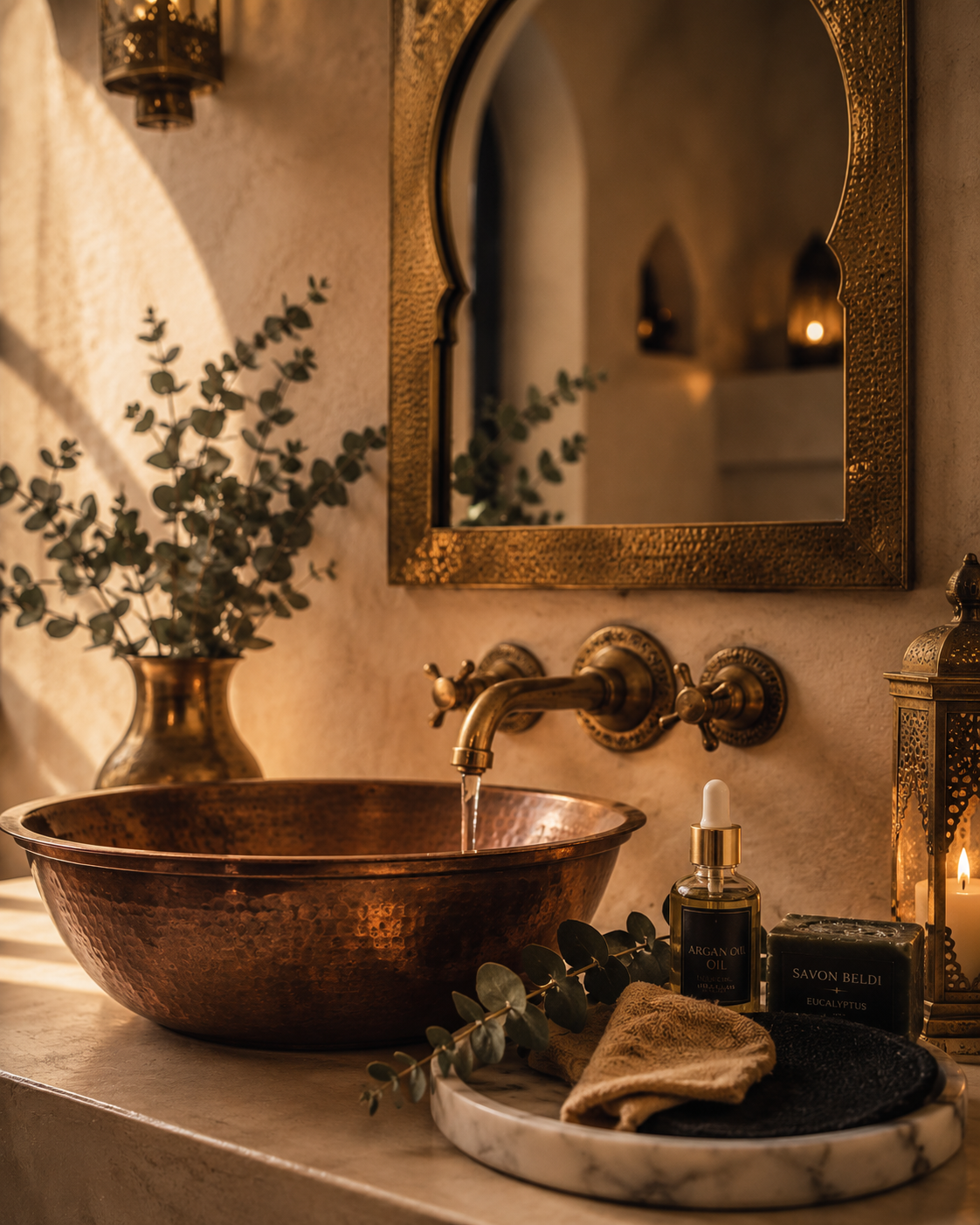
This post contains affiliate links. If you buy through our links, we may earn a small commission — at no extra cost to you. This helps us keep the blog running and sharing more tips for van life. Thank you for your support!
You Do Not Need a Riad. You Just Need to Know What Makes One Feel Magic.
Close your eyes for a moment and imagine this.
You are standing barefoot on cool zellige tiles — deep cobalt blue, hand-cut and slightly uneven, each one catching the morning light differently. The walls are warm and smooth, a soft ivory tadelakt plaster that seems to glow rather than simply reflect. A hammered brass tap drips slowly into a copper basin. The air smells of eucalyptus and black soap and something faintly floral — rose water, maybe, or the ghost of oud from the night before. A single brass lantern hangs from the ceiling, its pierced metalwork throwing geometric shadows across the floor like a moving piece of art.
This is a bathroom inside a riad in the Marrakech Medina. And it costs approximately $800 a night to sleep near it.
Now open your eyes and look at your actual bathroom. Maybe it has beige tiles from 2003. Maybe the light fitting is purely functional and purely ugly. Maybe the only scent is whatever cleaning product you used last Tuesday.
Here is the thing nobody in the interior design world says loudly enough: you do not need the $800-a-night riad to have that feeling. The feeling — that specific combination of warmth, pattern, texture, ritual, and light that makes a Moroccan bathroom stop you in your tracks — is surprisingly achievable on a fraction of the budget. Not a fake version of it. Not a sad approximation. The actual feeling, recreated intelligently, with full knowledge of where to spend and where to save.
That is exactly what this guide is for.
Before You Spend a Single Dollar: Understand What You Are Actually Recreating
Most Moroccan bathroom makeover attempts fail for the same reason: people buy a couple of lanterns and some geometric towels and wonder why the room still does not feel right. The problem is not the products. It is the absence of a design philosophy.
A genuine riad bathroom works because of five non-negotiable elements working together:
Pattern — geometric, bold, intentional. Not scattered, not random. One strong pattern that anchors the room.
Texture — rough plaster against smooth brass against woven cotton. The layering of different surface qualities is what makes the space feel rich rather than flat.
Color — whether warm neutral, deep jewel tone, or brilliant white, the palette is always deliberate and always warm. There is no cool grey in a Moroccan bathroom. No icy blue-white. Everything leans toward the warmth of sunlight, terracotta, and aged metal.
Light — atmospheric rather than clinical. Warm rather than white. Layered from multiple sources rather than blasted from a single overhead fitting.
Scent — argan oil, rose water, eucalyptus, savon beldi, oud. Moroccan bathrooms engage the nose as deliberately as the eyes. Scent is not an afterthought. It is part of the design.
Get these five elements right and your bathroom will feel Moroccan regardless of your budget. Miss even one of them and no amount of expensive tile will save it.
Throughout this guide, every section is organized into three budget tiers:
🟢 Renter / Minimal Budget — under $300 total, zero permanent changes
🟡 Homeowner Refresh — $300–$1,500, minor permanent changes allowed
🔴 Full Renovation — $1,500–$5,000, complete transformation
1: The Color Palette — Your Cheapest and Most Powerful Tool
Paint is the single most transformative thing you can do to any room, and in a bathroom it costs $40–$80 for a can that changes everything. Before you buy a single accessory, get the color right.
The critical rule of Moroccan color: always warm, never cool. The difference between a white that feels like a spa in Marrakech and a white that feels like a hospital corridor is about three degrees of warmth on the color wheel. Get it wrong and nothing else you do will fix it.
The Four Moroccan Bathroom Palettes
Palette 1 — Marrakech White and Brass
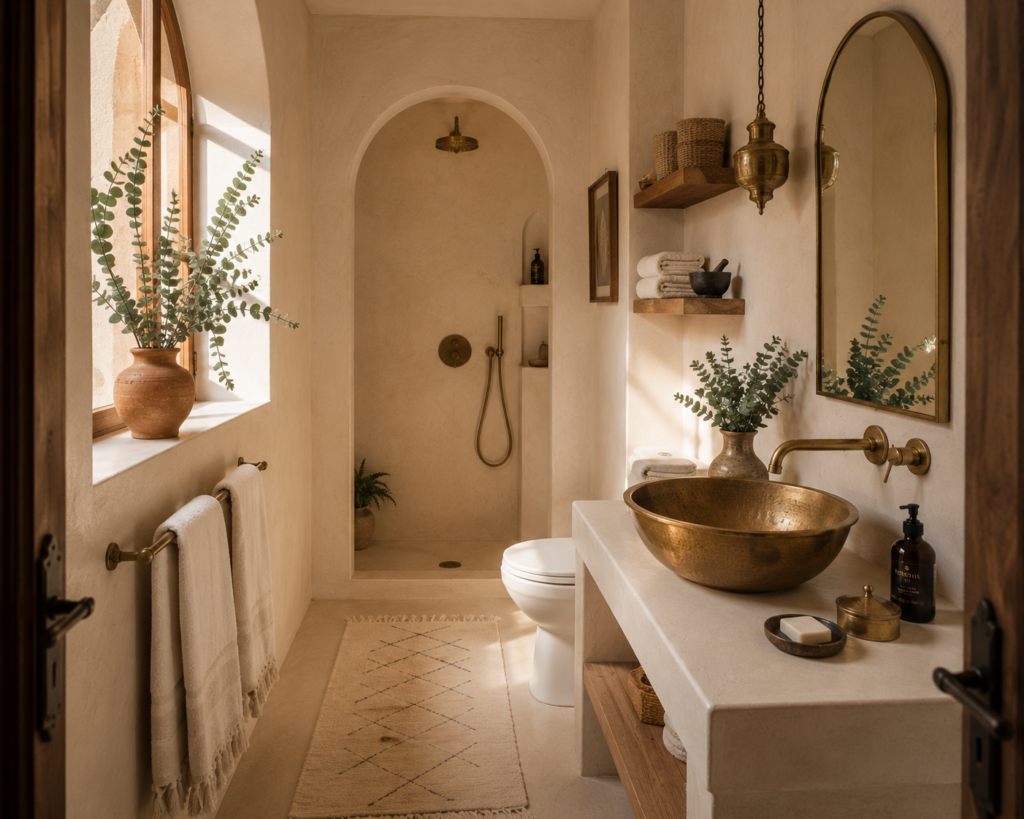
Warm white walls, aged brass fixtures, honey-toned wood, ivory linen. This is the most versatile palette — it works in small bathrooms, north-facing rooms, and rental properties where you need to repaint white before you leave anyway. Paint recommendation: Farrow & Ball Pointing (No.32), Benjamin Moore White Dove (OC-17), or Sherwin-Williams Alabaster (SW7008). All three read as warm and luminous rather than stark.
Palette 2 — Cobalt and Terracotta
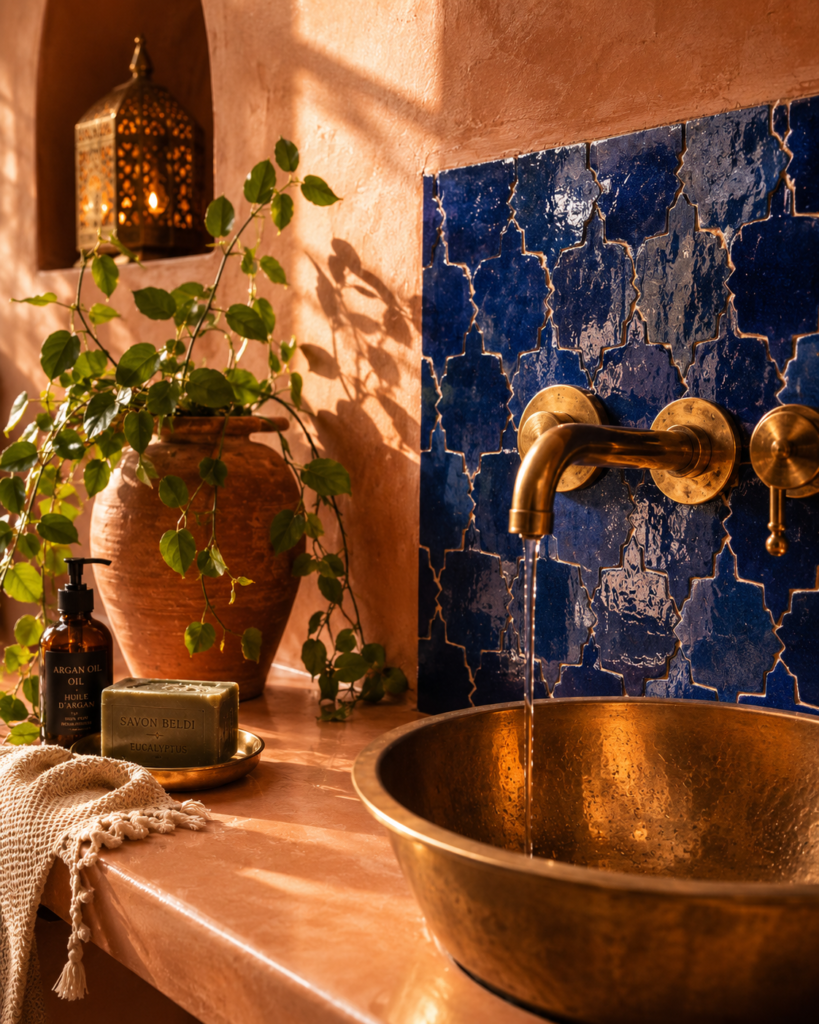
Sand or warm terracotta walls with cobalt blue tile or accessory accents and brass details. This is the palette most people picture when they think Moroccan — bold, energetic, unmistakably Medina-inspired. Paint recommendation: Benjamin Moore Pale Chestnut (2175-40) for walls, or Farrow & Ball Red Earth (No.64) for a bolder commitment.
Palette 3 — Forest Green and Gold
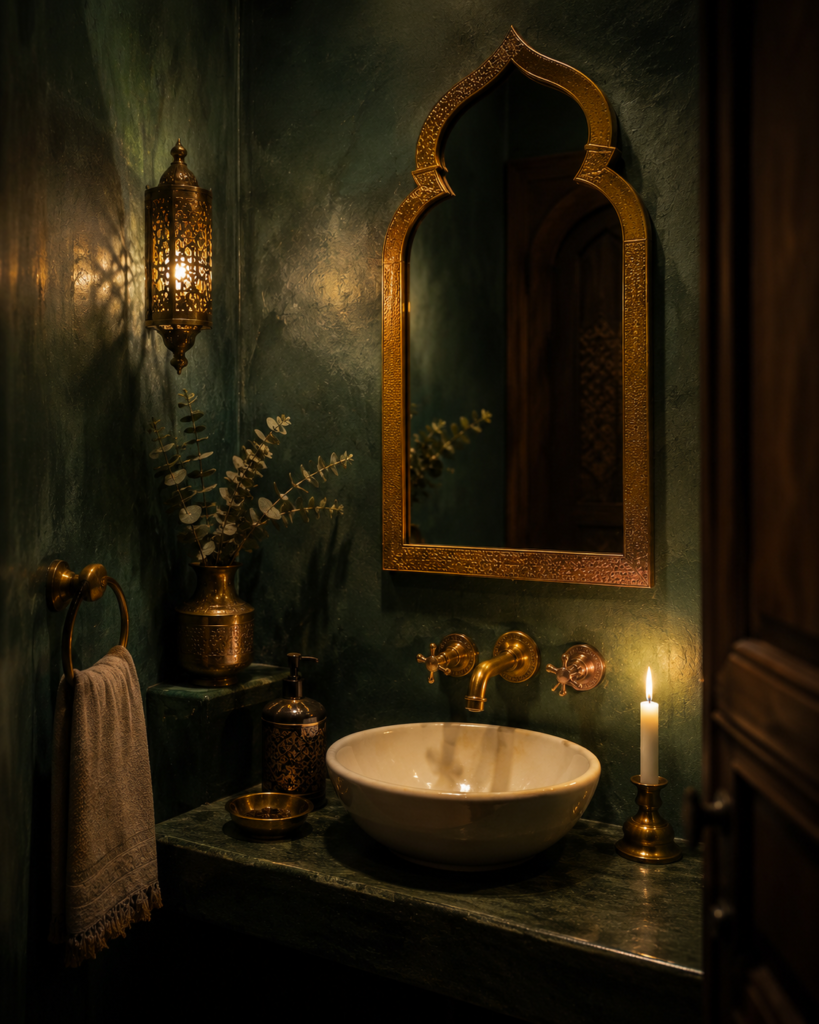
Deep botanical green walls with gold brass hardware, white marble or ivory ceramic, and natural linen. This palette photographs extraordinarily well and works particularly in powder rooms or smaller bathrooms that can carry the drama. Paint recommendation: Farrow & Ball Calke Green (No.80) or Benjamin Moore Hunter Green (2041-10).
Palette 4 — All-White Hammam
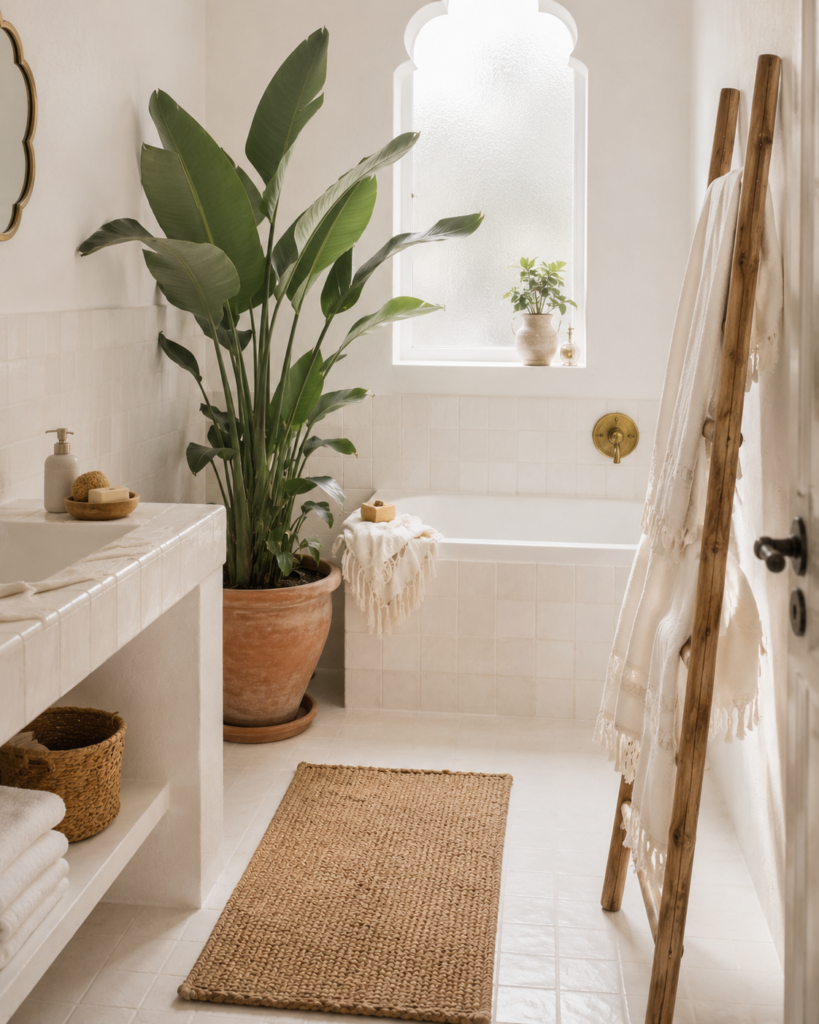
Warm white throughout — walls, ceiling, grout — with texture doing all the work. Natural wood, woven cotton, terracotta pots, eucalyptus. This is the most forgiving palette for renters and the most enduringly elegant. The key is keeping every white in the room from the same warm family — mixing warm and cool whites looks accidental rather than intentional.
One color tip that designers rarely share: paint your ceiling the same color as your walls. In a small bathroom especially, it creates an immersive, cocoon-like quality — the walls seem to melt into the ceiling and the room feels intentionally designed rather than decorated. It costs nothing extra and makes an enormous difference.
2: The Floor — Your Biggest Visual Statement
The floor is where Moroccan bathrooms announce themselves. A strong floor pattern does more design work than almost any other single element in the room.
Renter Budget (Under $100)
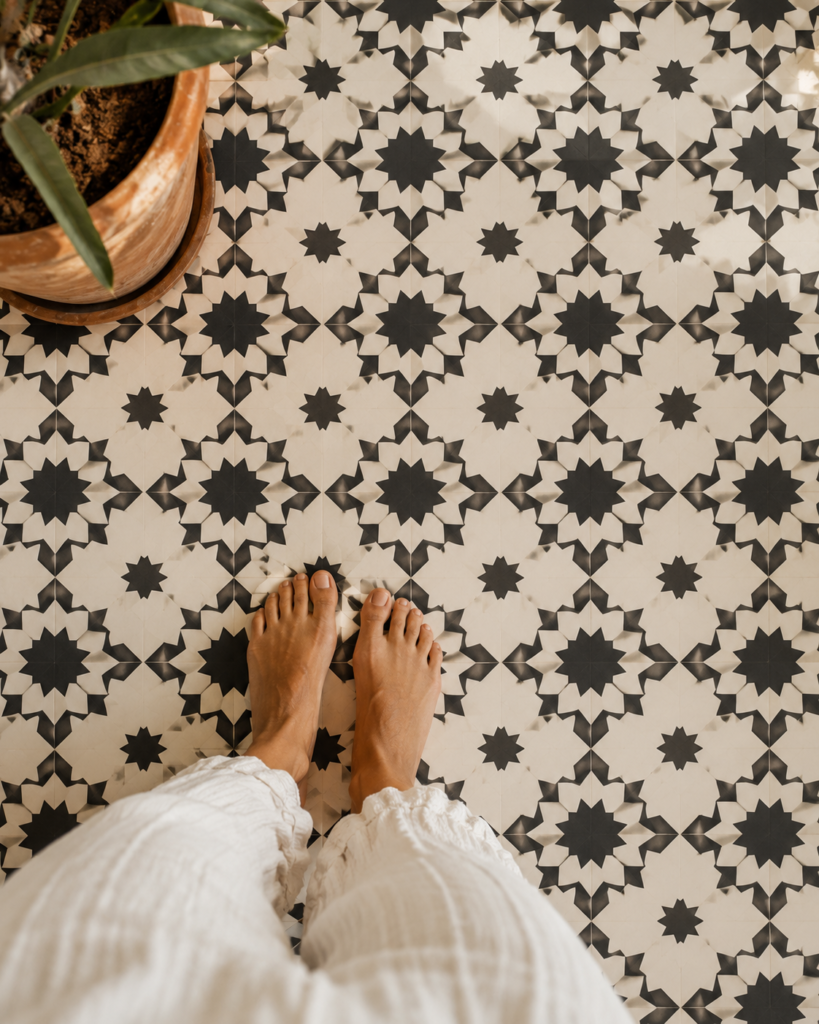
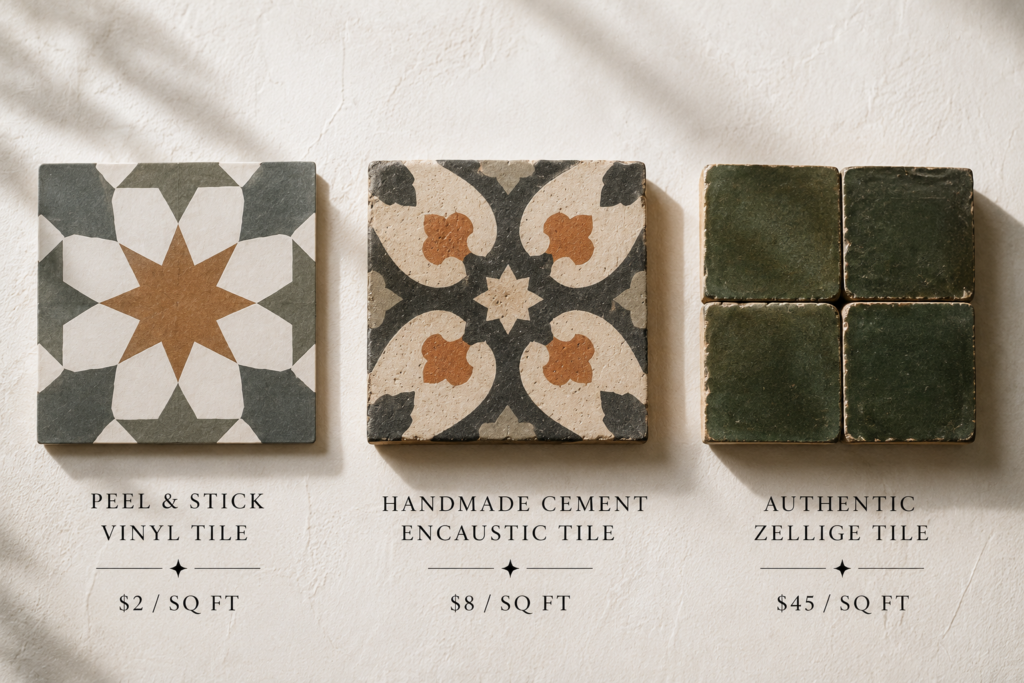
Peel-and-stick vinyl tiles have improved dramatically in the last five years. The best versions — from brands like Stickytiles, FloorPops, and Tile Style Decor — use genuine Moroccan geometric patterns in colors accurate enough to read convincingly from standing height. They will not fool anyone who gets down on their hands and knees, but in photographs and in daily life they do a surprisingly respectable job.
What to look for: a matte rather than glossy finish (glossy reads as cheap), a pattern with at least three colors (single-color peel-and-stick rarely looks convincing), and a geometric rather than floral repeat. Install them over a clean, smooth surface and use a roller to press out every air bubble. Cost: $40–$80 for a standard bathroom floor.
Homeowner Budget ($100–$600)
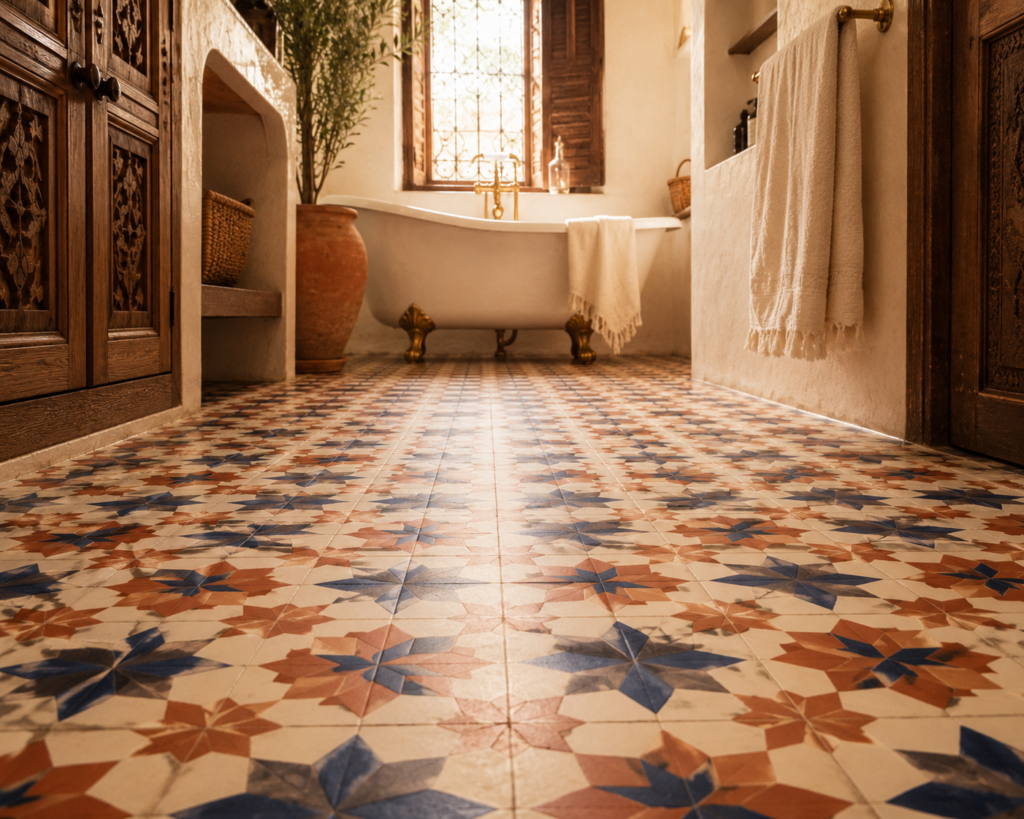
Cement encaustic tiles are the best zellige alternative at an accessible price. They are handmade, slightly irregular, available in authentic Moroccan geometric patterns, and cost $4–$12 per square foot — a fraction of genuine zellige. Sources: Cement Tile Shop, Granada Tile, and Clé Tile all carry excellent Moroccan-inspired ranges. Moroccan-pattern ceramic tiles from TileBar, Wayfair, or even Home Depot’s premium range have also improved significantly and can be found for $3–$8 per square foot in genuinely beautiful geometric patterns.
The grout color you choose matters as much as the tile itself. Dark grey or charcoal grout with a geometric tile creates a defined, graphic look that reads as intentional. White grout with a colorful tile can look washed out. Test a small section before committing.
Full Renovation ($600–$2,500)
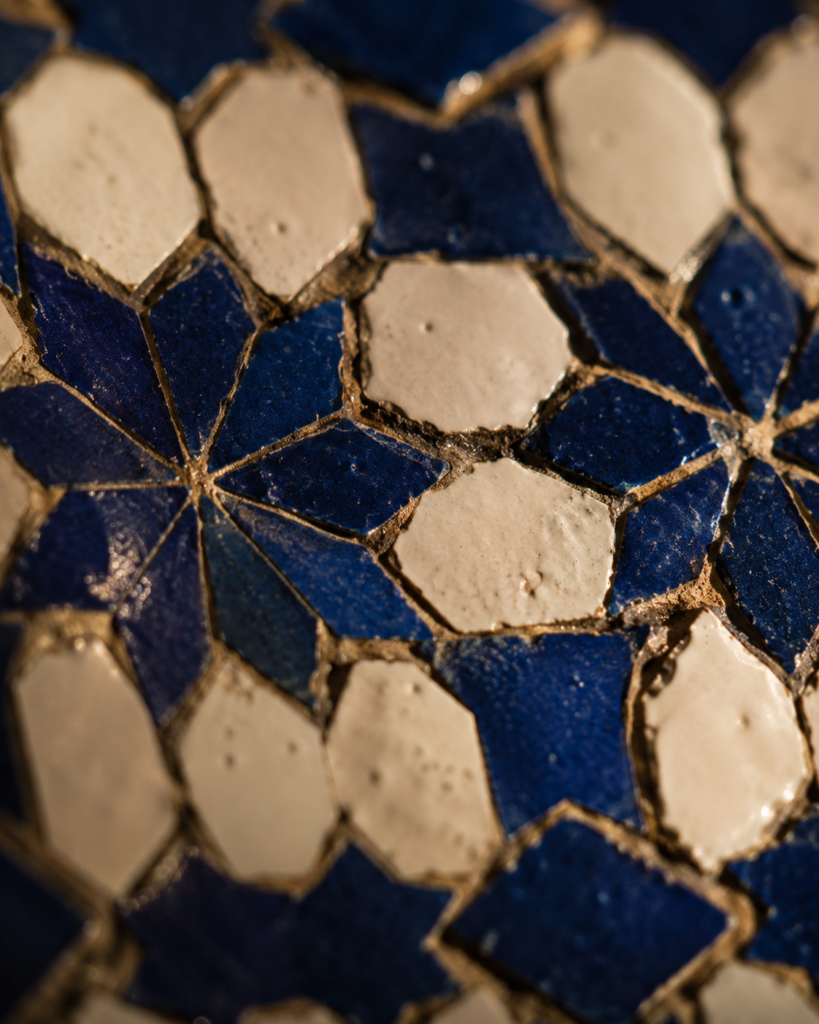
Authentic zellige tile — hand-cut, hand-glazed ceramic from Fez — costs $25–$80 per square foot installed. It is expensive, but nothing else looks like it. The slight irregularity of hand-cut zellige, the way each tile catches light at a slightly different angle, the barely perceptible variation in glaze — these are qualities that no machine-made tile fully replicates. If your budget allows for zellige anywhere, put it on the floor. It is the decision you will never regret.
Handmade Moroccan cement tile in traditional patterns — available from specialist importers — sits in the middle ground at $8–$20 per square foot and is genuinely beautiful.
3: The Walls — Texture Is Everything
If the floor is about pattern, the walls are about texture. The characteristic quality of a Moroccan bathroom wall — that warm, organic, slightly luminous surface that seems to have depth rather than flatness — comes from tadelakt plaster, and it is the hardest element to recreate on a budget. But it can be done.
Renter Budget (Under $150)
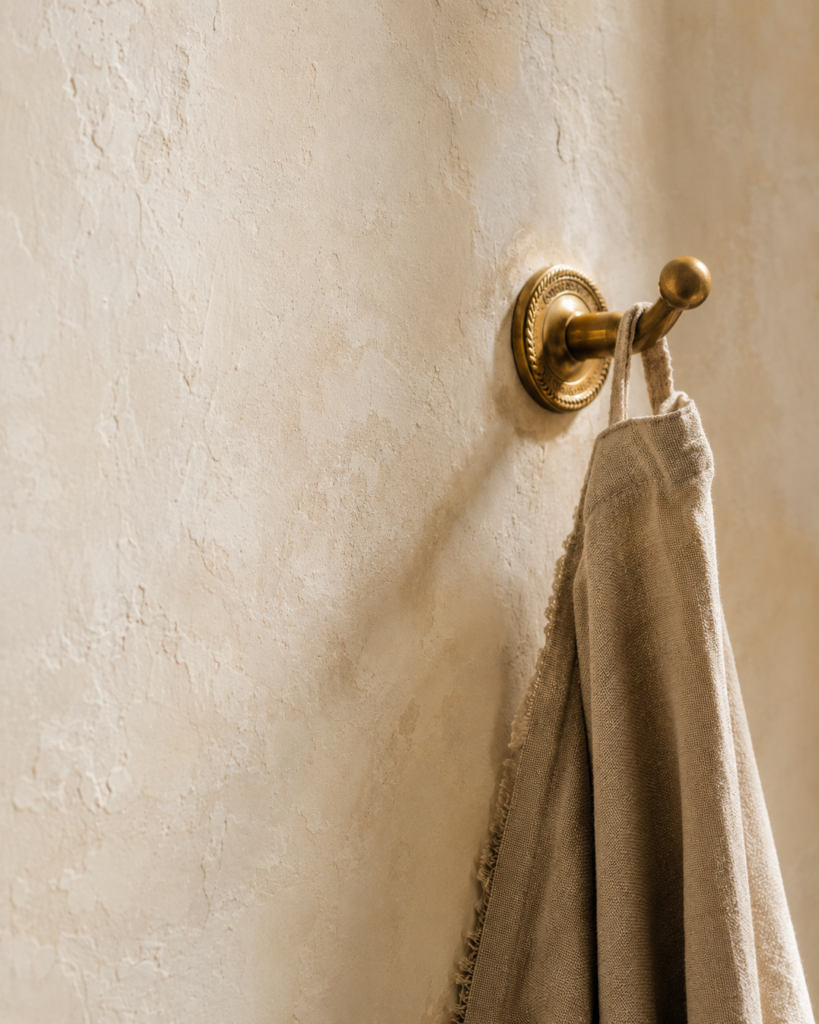
Limewash paint is the single most transformative budget option available to renters and budget decorators. Applied in thin, overlapping layers with a wide brush and then partially wiped back while still wet, limewash creates a surface with genuine depth — cloudy, slightly irregular, with tonal variation across the wall that reads remarkably similarly to tadelakt from any normal viewing distance.
Brands to look for: Portola Paints Roman Clay (an American cult favorite), Romabio Classico Limewash (Italian formula, beautiful results), and LICK Limewash (UK-based, excellent color range). Cost: $40–$80 per can covering approximately 250 square feet. Application is genuinely easier than it looks — watch two or three YouTube tutorials and you will be confident enough to start.
For renters worried about repainting before leaving: limewash paint actually rolls over easily with standard white emulsion, so restoration is simpler than you might think.
Removable geometric wallpaper is the other renter option — effective on a single feature wall behind a mirror or vanity. Look for pattern scales that suit your wall size and stick to warm colorways rather than the cooler greys that read as more Nordic than Moroccan.
Homeowner Budget ($150–$800)
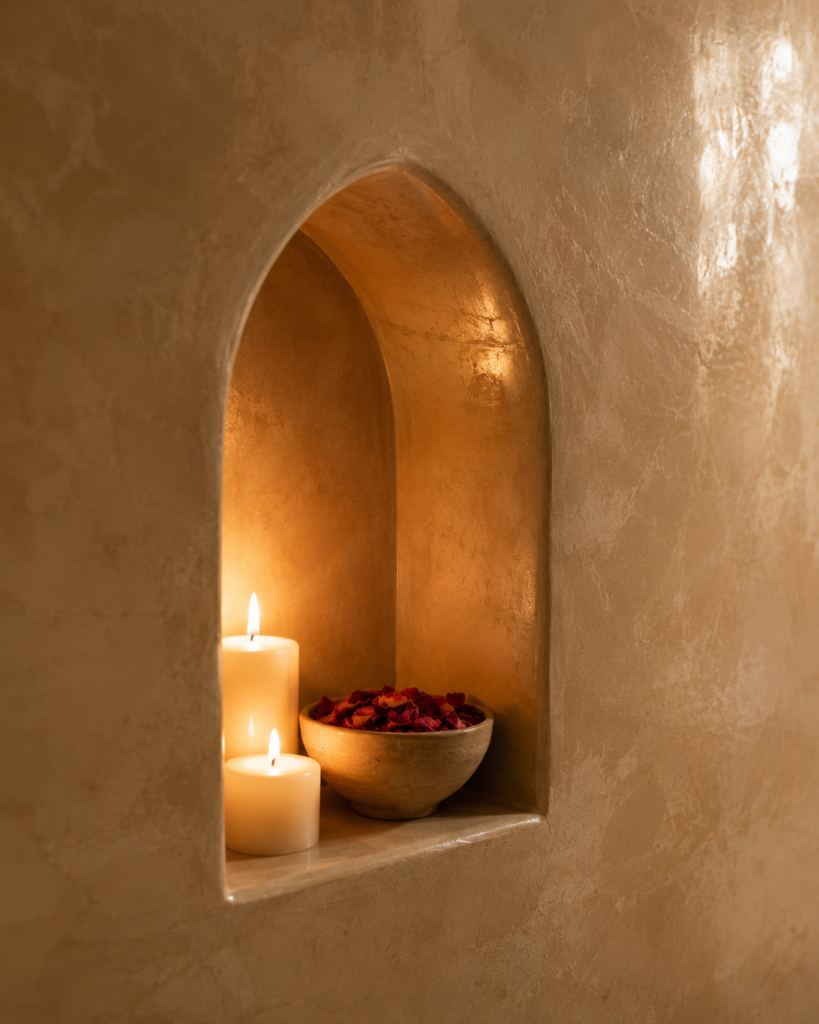
Venetian plaster takes the limewash effect several steps further — it has more depth, more luminosity, and a more convincing imitation of genuine plasterwork. Applied in two or three thin layers and polished with a metal trowel, it creates a surface with subtle variation and warmth that photographs like a dream. Cost: $60–$120 for the material for a full bathroom. Application takes a weekend and some patience but no professional skills.
A single wall of Moroccan-pattern cement tiles as a feature — behind the vanity, around the bath, or as a shower wall — combined with limewash paint on the remaining walls is a beautifully balanced and cost-effective approach. One strong surface. Three supporting surfaces. The classic riad proportion.
Full Renovation ($800–$3,000)
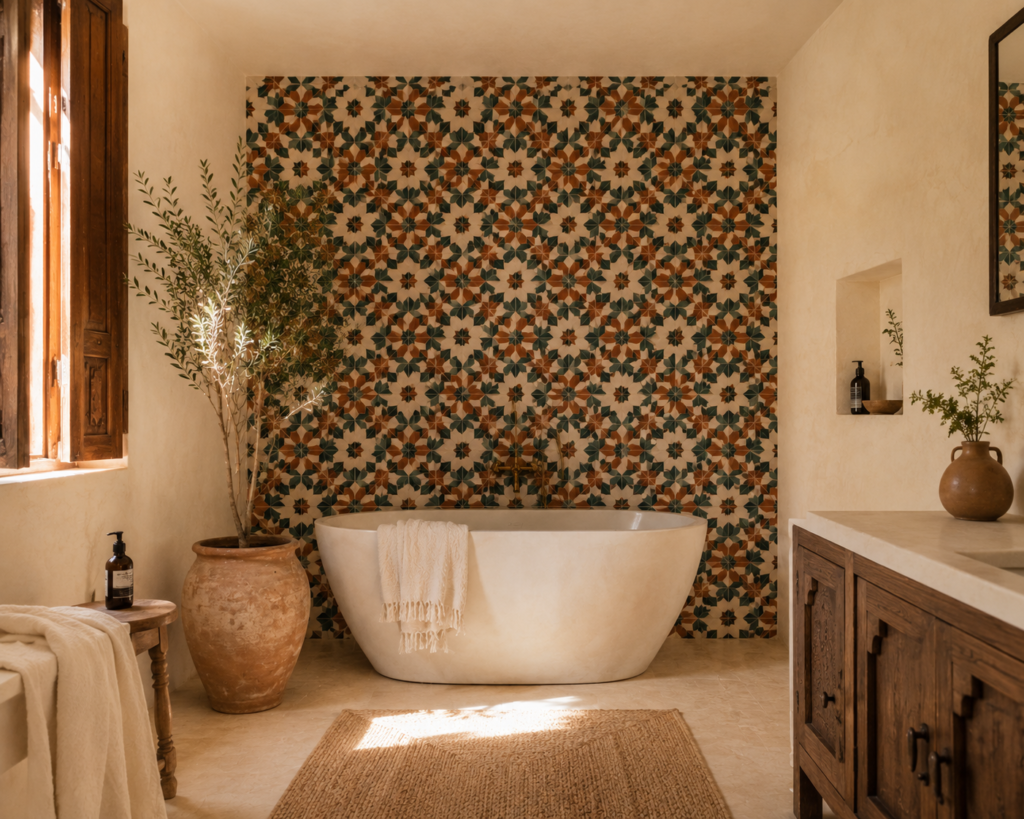
Professional tadelakt plaster — applied by a specialist who knows the traditional technique, polished with a river stone, and treated with black soap — costs $50–$150 per square foot installed. It is a genuine investment and a genuine luxury. In a small bathroom of 40–60 square feet of wall space, budget $2,000–$4,000 for full professional tadelakt. It is worth every penny if budget allows.
A carved plaster niche around a mirror or recessed into a shower wall adds architectural authenticity that no accessory can replicate. Specialist plasterers who work in the Moroccan tradition can create these for $300–$800 depending on complexity.
4: The Fixtures — Where Small Budgets Make the Biggest Impression
Here is the design secret that expensive bathroom renovations rely on: the hardware does the heavy lifting. Swap the taps and the mirror and the towel rail for brass equivalents and the room shifts register entirely — even if nothing else changes.
The Mirror: Your Single Most Impactful Purchase
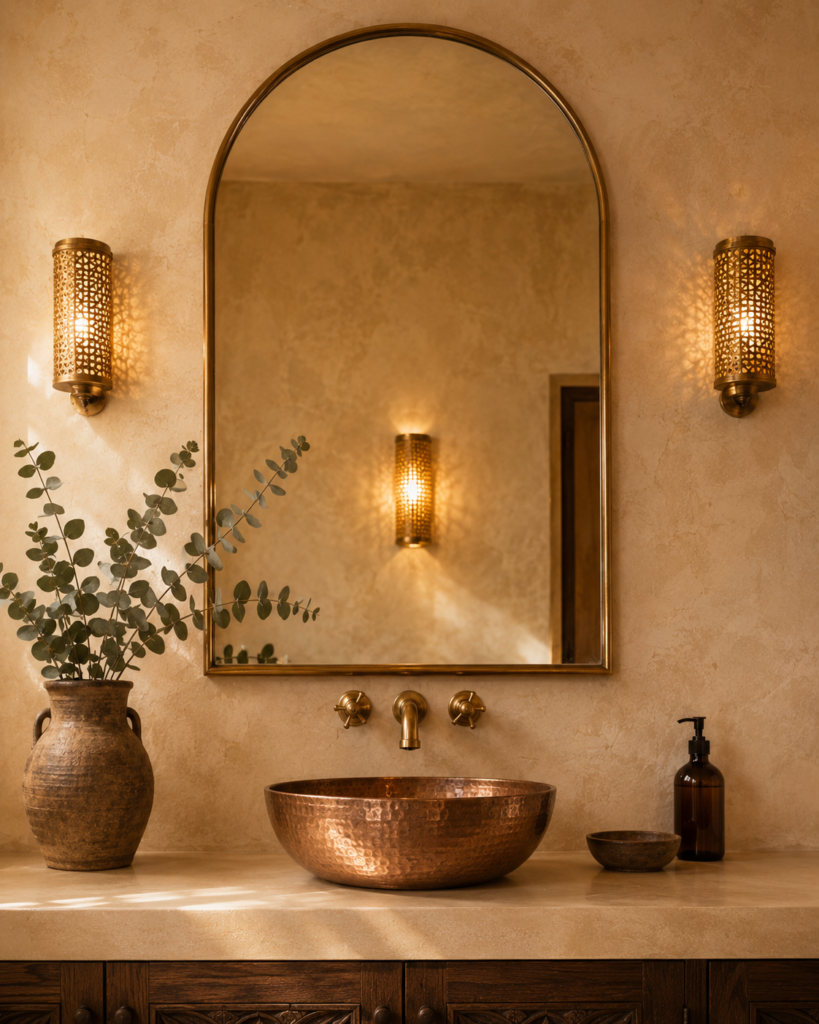
In a Moroccan bathroom, the mirror is rarely just a mirror. It is arched. It is framed in hammered brass or zellige mosaic. It is disproportionately large. It reflects the lantern light and doubles the sense of space and warmth.
A good arched brass mirror costs $80–$200 from sources like Anthropologie, World Market, CB2, or Etsy. At the budget end, Amazon and Wayfair carry arched mirrors from $35–$65 that photograph well and hold up in daily use. At the splurge end, handmade Moroccan mirrors imported via specialist Etsy sellers run $200–$600 and are genuinely extraordinary objects.
If you already have a plain rectangular mirror you like, frame it yourself: brass trim from a hardware store, cut to size and glued with construction adhesive, transforms a basic mirror into something that looks custom-made. Cost: $20–$40 in materials.
The Taps: The Detail That Changes Everything
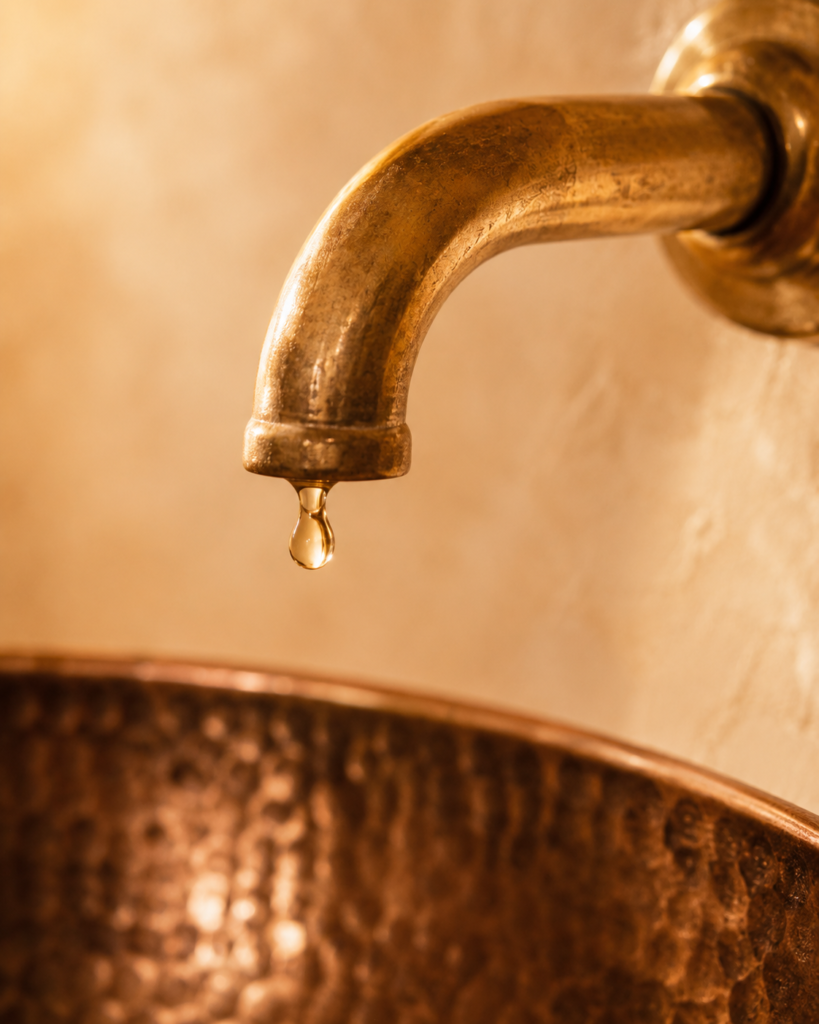
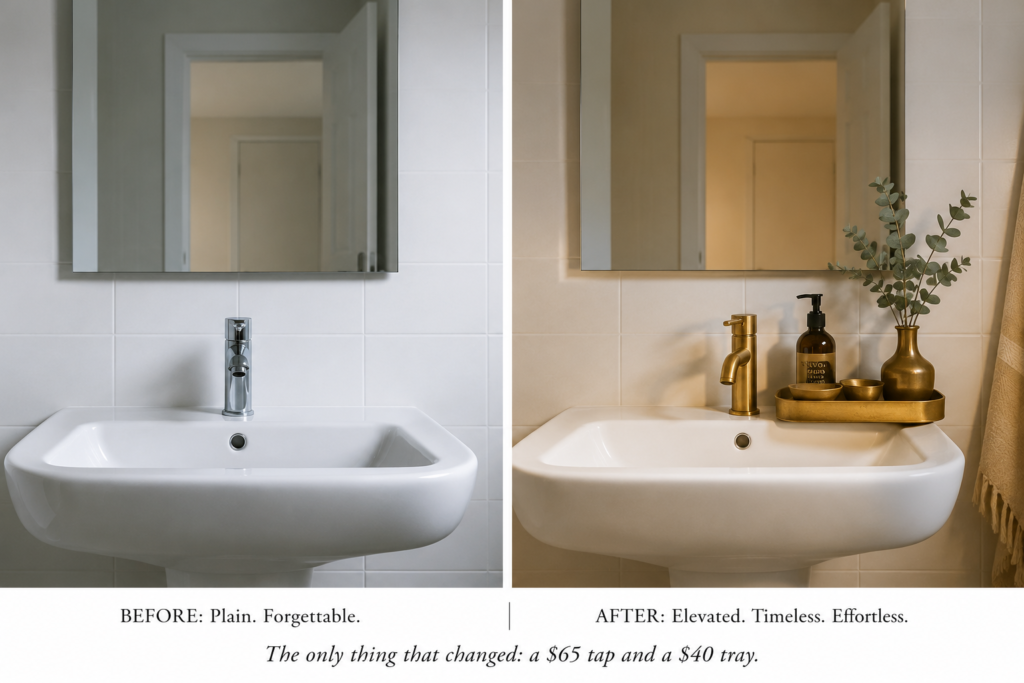
Nothing signals bathroom quality — or its absence — faster than the tap. A chrome tap on an otherwise Moroccan-styled vanity creates a jarring discontinuity. A brass tap, even an inexpensive one, pulls the entire room together.
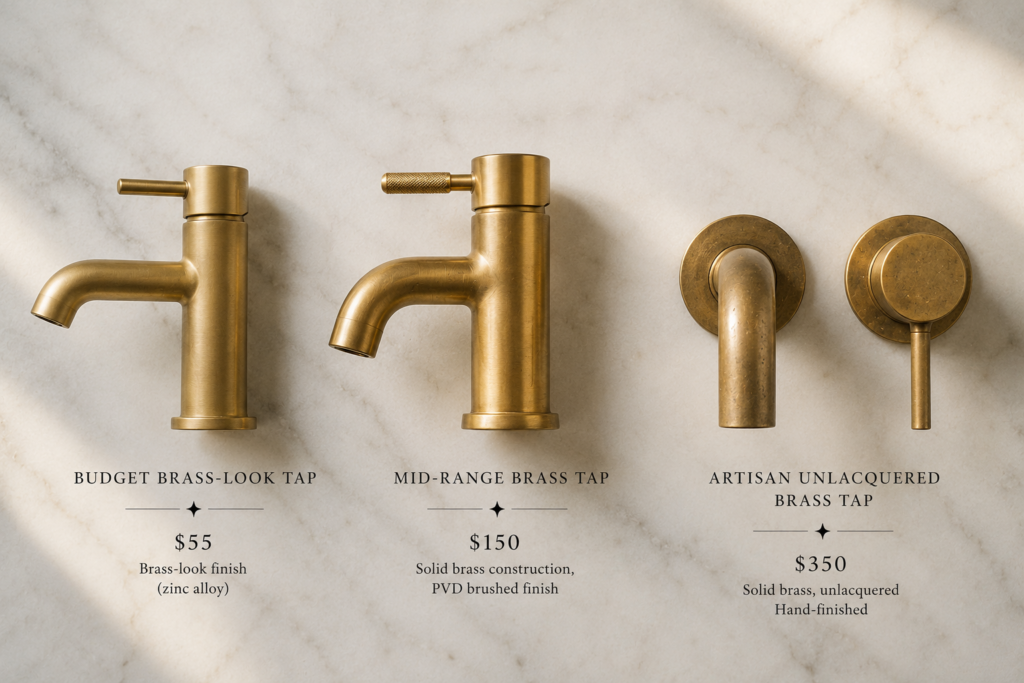
🟢 Budget: Brass-look taps from Amazon or Wayfair run $40–$80 and look convincing in the warm color temperatures that Moroccan bathroom lighting creates. Search specifically for “unlacquered brass” or “antique brass” rather than “polished brass” — the latter reads as too shiny and too new.
🟡 Mid-range: Kingston Brass, Signature Hardware, and Moen’s Weymouth range offer genuine brass construction at $80–$200 with finishes that patina naturally over time.
🔴 Splurge: Wall-mounted brass taps from specialist suppliers — Waterworks, Brodware, or direct-import artisan pieces from Moroccan craftsmen via Etsy — run $200–$600 and are built to last decades.
The Basin
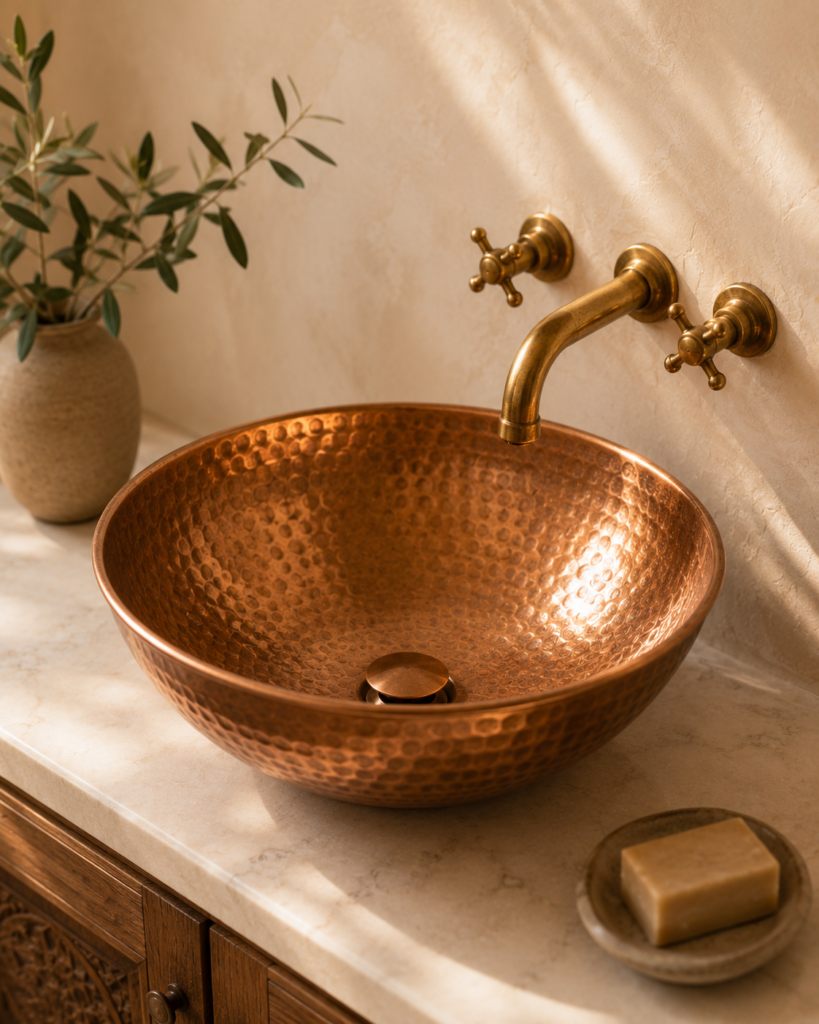
A hammered copper vessel sink — sitting on top of a vanity rather than built into it — is one of the most visually striking elements in a Moroccan bathroom. Genuine handmade copper basins cost $150–$400 from Etsy artisan sellers and specialist importers. Paired with a wall-mounted brass tap, the combination is immediately and unmistakably Moroccan.
At the budget end: a simple white ceramic basin costs $30–$80 and is not the element to splurge on if budget is tight. Put the money into the tap and mirror instead — they do more visual work.
Lighting: Where Most Attempts Fail
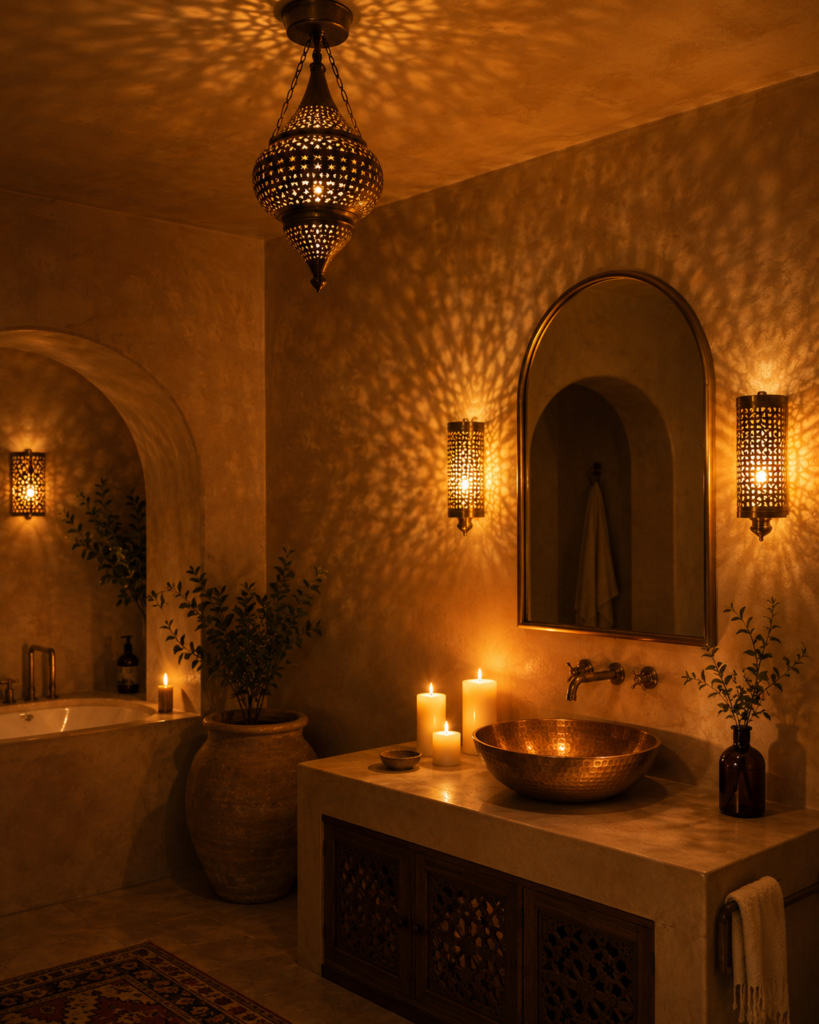
The overhead LED panel — standard in most modern bathrooms — is the single biggest enemy of a Moroccan atmosphere. It is too bright, too white, too clinical. It flattens texture, kills warmth, and makes brass look like plastic.
Replace it, supplement it, or override it:
🟢 Renter solution: Add two table-height brass lanterns on the floor or windowsill. Add candles in brass holders on the vanity. Switch your existing bulb to a warm Edison-style filament at 2700K. These three things together cost $40–$60 and transform the atmosphere entirely.
🟡 Mid-range: Wall-mounted brass sconces flanking the mirror at eye level — the most flattering and functional bathroom lighting position — cost $60–$150 per pair from sources like Pottery Barn, West Elm, and Etsy. Pair with a Moroccan pendant or lantern overhead for layered light.
🔴 Full renovation: Recessed lighting on a dimmer, supplemented by brass wall sconces and a statement Moroccan lantern pendant, gives you full control of atmosphere from bright and functional to candlelit and cinematic.
The target color temperature for all bulbs: 2700K–2900K. Warm white. Never cool white. Never daylight.
5: The Accessories — Where Budget Buyers Win Completely
This is the great equalizer of Moroccan bathroom design. The accessories that complete the look — the hammam shelf, the fouta towels, the savon beldi, the eucalyptus — cost almost nothing and have an impact completely disproportionate to their price.
The Hammam Shelf
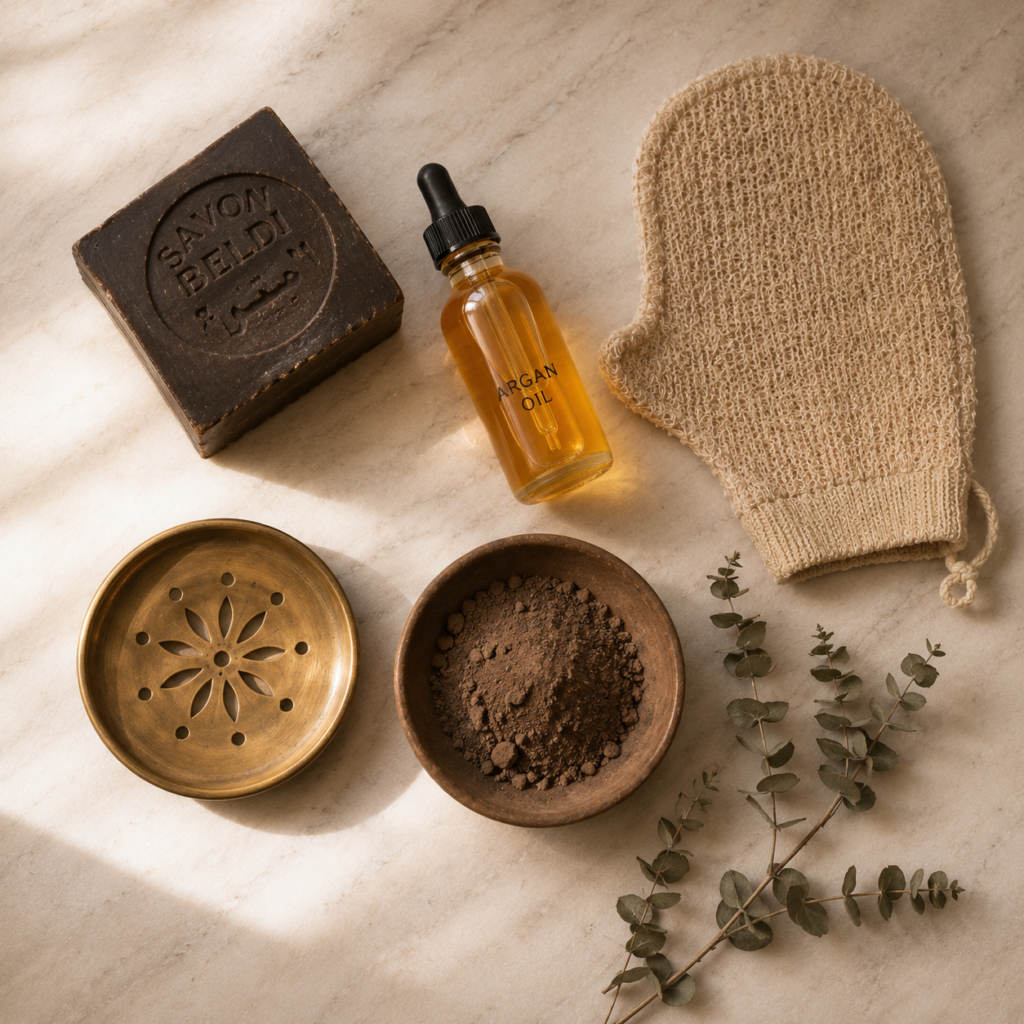
The single most effective $40 investment in Moroccan bathroom design. A small wooden shelf or marble tray, styled with:
- A glass or ceramic bottle of argan oil
- A bar of savon beldi (Moroccan black soap)
- A kessa exfoliation glove in natural fiber
- A small clay or ceramic bowl of ghassoul (Moroccan clay)
- A brass or terracotta soap dish
- A few sprigs of dried eucalyptus or rose
This collection of objects — all of them functional, all of them authentic to the Moroccan hammam tradition — looks like a luxury spa styling shoot and costs $30–$50 in total. Sources: Ayla Beauty, Shea Terra Organics, and numerous Etsy sellers carry genuine Moroccan hammam products at honest prices.
Textiles
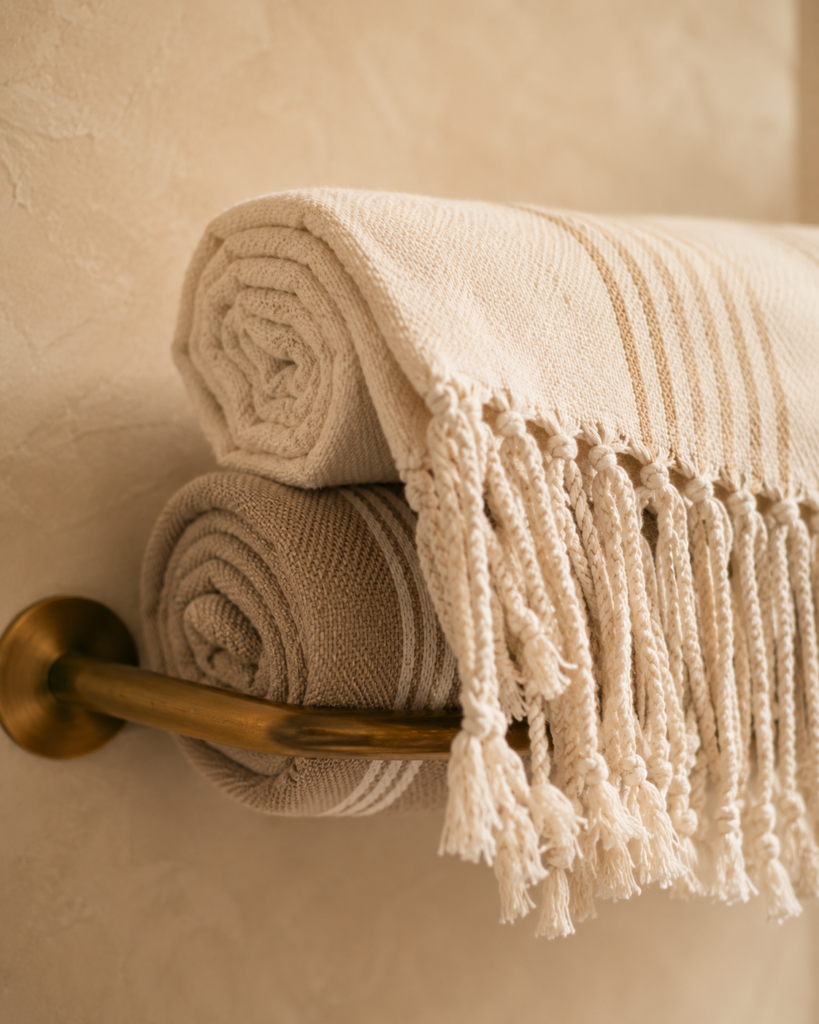
Hammam fouta towels — the traditional flat-woven Turkish-Moroccan towels — are one of the great bargains in home textiles. Lightweight, fast-drying, beautiful in the way they drape and roll, they cost $15–$30 each from sources like Turk Tekstil, Peshtemal City, and numerous Etsy shops. Look for 100% cotton construction and hand-loomed rather than machine-made where possible.
Rolled and stacked on a brass rail or arranged in a wicker basket, fouta towels transform a bathroom shelf from functional to beautiful in thirty seconds.
For the floor: a small Moroccan wool rug or a fouta laid flat beats any bath mat for authenticity. A genuine Moroccan cotton rug from Beni Living or Moroccan Bazaar costs $40–$80 and lasts for years.
Scent: The Most Underestimated Design Element
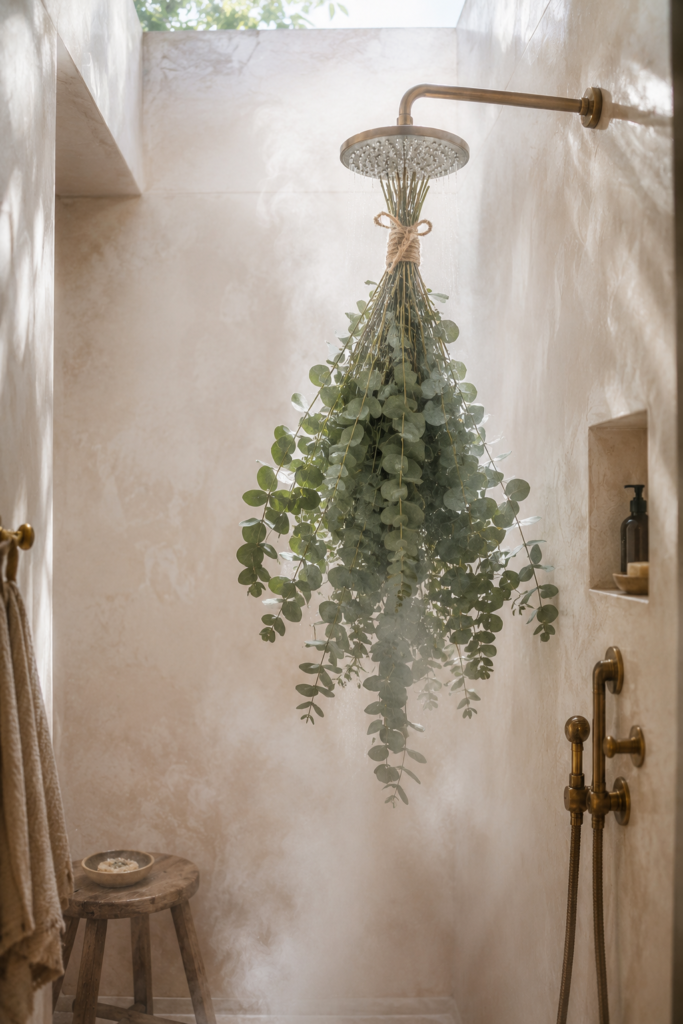
Close your eyes in a Moroccan riad bathroom and you know exactly where you are. The scent is as much a part of the design as the tiles.
A eucalyptus branch tied to your shower head with twine costs $3 at a florist and releases its scent every time the hot water runs — one of the most effective and most beautiful bathroom tricks there is. Replace it weekly.
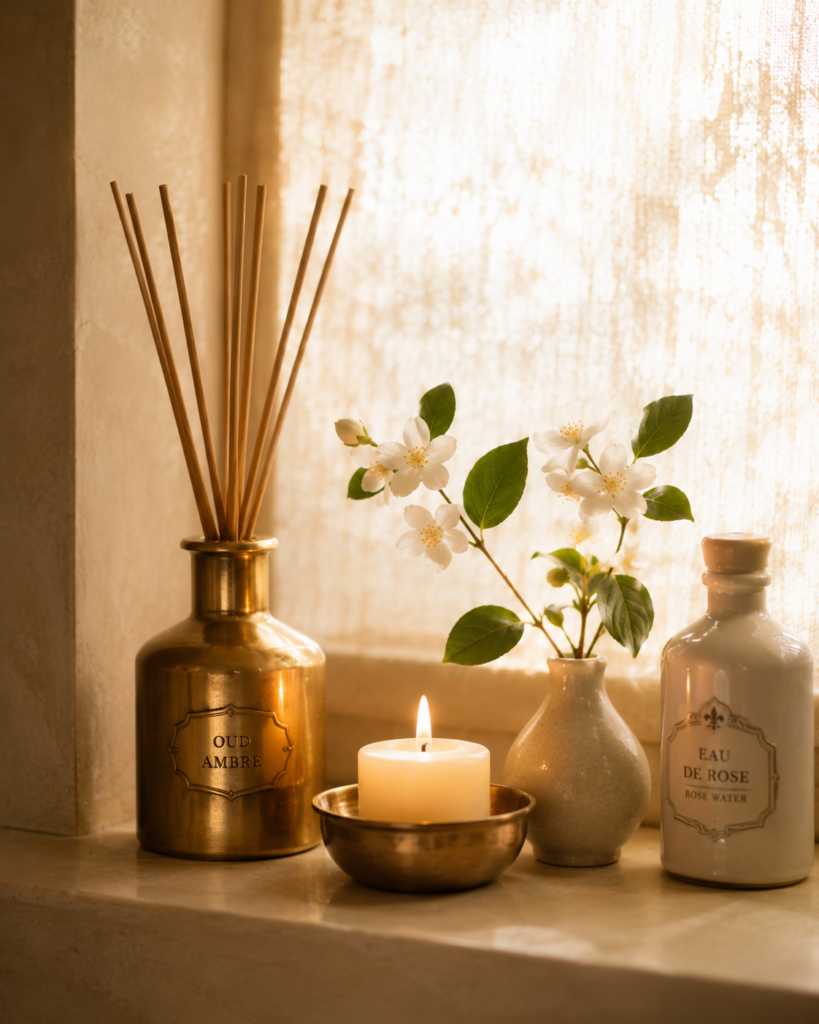
A reed diffuser in oud, rose, or eucalyptus from brands like Rituals, Maison Berger, or Baobab Collection maintains a constant background scent. Candles in brass holders add atmosphere and scent simultaneously. Fresh jasmine in a small vase, in season, smells precisely like a Marrakech courtyard in April.
Budget $20–$40 on scent and it will do as much for the atmosphere of your bathroom as $200 spent on accessories.
6: The Complete Budget Breakdowns
The Renter Transformation — Under $300
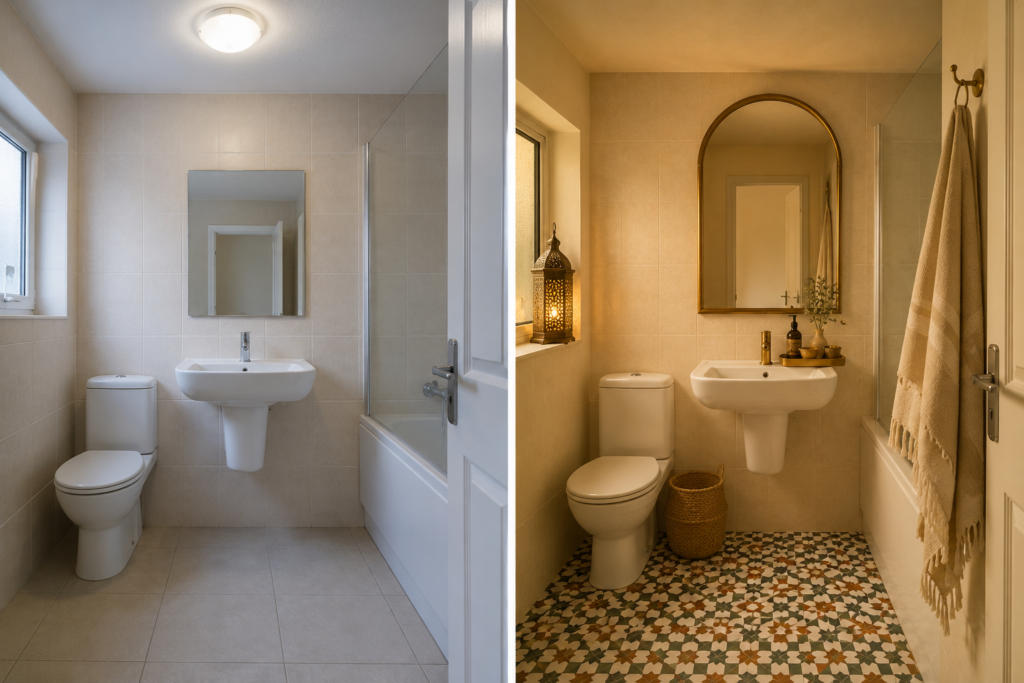
Zero permanent changes. Maximum impact.
| Item | Cost |
|---|---|
| Limewash paint — one feature wall | $45 |
| Arched brass mirror (Wayfair or Amazon) | $65 |
| Brass adhesive hooks (set of 4) | $20 |
| Hammam fouta towels x2 | $35 |
| Moroccan lantern — battery powered | $25 |
| Hammam shelf accessories (argan oil, savon beldi, kessa) | $40 |
| Peel-and-stick geometric floor tiles | $55 |
| Eucalyptus, candles, reed diffuser | $25 |
| Total | $310 |
Result: a bathroom that stops guests in the doorway.
The Homeowner Refresh — $300–$1,500
Minor permanent changes. Dramatic transformation.
| Item | Cost |
|---|---|
| Venetian plaster paint — full room | $120 |
| Moroccan cement tile floor | $400 |
| Brass tap replacement | $150 |
| Arched brass or zellige-framed mirror | $180 |
| Brass towel rail | $80 |
| Wall-mounted brass sconces x2 | $120 |
| Hammam textiles and accessories | $100 |
| Styling accessories and scent | $80 |
| Total | $1,230 |
Result: a bathroom that looks like a $5,000 renovation.
The Full Renovation — $1,500–$5,000
Complete transformation. Every element considered.
| Item | Cost |
|---|---|
| Professional tadelakt plaster walls | $1,200 |
| Zellige tile floor | $800 |
| Brass wall-mounted taps | $280 |
| Hammered copper vessel sink | $350 |
| Custom arched mirror with brass frame | $400 |
| Brass lighting fixtures | $300 |
| Carved plaster niche detail | $400 |
| Premium hammam textiles | $200 |
| Styling, scent, and accessories | $150 |
| Total | $4,080 |
Result: a bathroom that makes people ask if you just got back from Marrakech.
Where to Shop — The Complete Source Guide
For tiles: Cement Tile Shop, Granada Tile, and Clé Tile for handmade cement tiles. TileBar and Wayfair for affordable Moroccan-pattern ceramic. Zia Tile and Mosaic House for authentic zellige. Budget option: search “Moroccan pattern peel and stick tile” on Amazon — filter for matte finish and four-star reviews minimum.
For fixtures and hardware: Budget brass taps: search “unlacquered brass bathroom faucet” on Amazon or Wayfair — set a $50–$80 filter. Mid-range: Kingston Brass and Signature Hardware both have excellent Moroccan-adjacent ranges. Hammered copper basins: Etsy sellers MoroccanBazaar, CopperSmith, and ArtisanMorocco all ship internationally.
For mirrors: Anthropologie and CB2 for mid-range arched brass mirrors ($120–$250). World Market and Target for budget arched mirrors ($40–$80). Etsy for handmade Moroccan mirrors at every price point — search “Moroccan arch mirror brass” and filter by seller location for the most authentic pieces.
For textiles: Peshtemal City and Turk Tekstil for genuine fouta hammam towels at wholesale-adjacent prices. Beni Living and Moroccan Bazaar for authentic Moroccan rugs and bath textiles. IKEA’s HILLESJÖN and TIDTABELL ranges are surprisingly good budget alternatives.
For hammam products: Ayla Beauty carries one of the best English-language selections of genuine Moroccan hammam products. Shea Terra Organics for argan oil and black soap. Etsy for artisan savon beldi, kessa gloves, and ghassoul from Moroccan sellers who ship internationally.
For paint: Portola Paints Roman Clay for the best limewash effect in the US. Romabio for the most authentic European lime formula. Farrow & Ball for the most beautiful warm whites. LICK for an excellent UK-based limewash range with color matching to Farrow & Ball shades.
The Bathroom That Changes How You Start Every Day
Here is what nobody tells you about a bathroom that genuinely moves you.
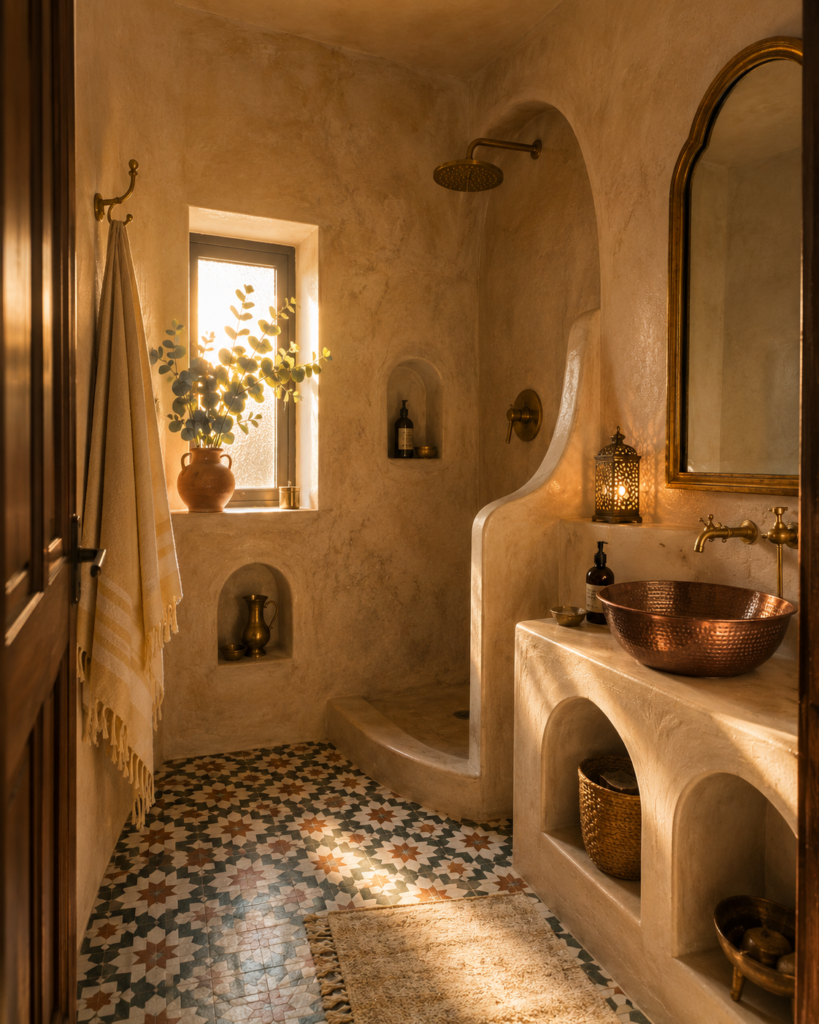
It is not about the money. It is not about the square footage. It is not even really about the tiles or the taps or the mirror, though all of those things matter. It is about walking into a room first thing in the morning and feeling, for just a moment, like you are somewhere extraordinary. Like your life is a little more beautiful than it was yesterday. Like the person who designed this space — you — has good taste and a genuine understanding of what makes a room feel alive.
That feeling is available to you at $300. It is available to you as a renter who cannot drill a single hole in the wall. It is available through a $45 can of limewash paint and a $65 mirror and a hammam shelf that cost $40 to style and smells like a Marrakech morning.
You do not need to fly to Morocco to have a Moroccan bathroom. You need pattern, texture, warmth, atmospheric light, and the right scent. You need one strong design decision and the confidence to commit to it.
Pick one element from this guide — just one — and do it this weekend. Order the mirror. Buy the limewash paint. Tie a bunch of eucalyptus to your shower head and run the hot water.
See how it feels.
Then come back for the next thing. And the next. And before long you will have a bathroom that makes people stop in the doorway, tilt their head slightly, and ask: did you just get back from Marrakech?
Which element are you starting with? Tell us in the comments — and share a photo when your bathroom is done. We would genuinely love to see it.
Recommended Products
🎨 Romabio Classico Limewash Paint
The closest thing to authentic tadelakt plaster for renters and DIYers. Italian-made, zero VOCs, one coat, and completely removable. The single most transformative thing you can do to a bathroom wall.
👉 Romabio Classico Limewash Paint – Amazon
🟦 Moroccan Peel-and-Stick Tile Stickers (40-Pack)
The renter’s secret weapon. Matte finish, geometric Moroccan pattern, water-resistant, and completely removable. Transforms a bathroom floor in an afternoon with zero commitment.
👉 Classic Moroccan Peel and Stick Tile Stickers – Amazon
🧱 Handmade Cement Moroccan Tiles (Black & White)
For the homeowner ready to commit — authentic handmade cement tiles in a classic Moroccan geometric pattern. The kind of floor that makes guests stop and stare.
👉 Moroccan Mosaic & Tile House Handmade Cement Tiles – Amazon
🪞 Arched Brass Bathroom Mirror (24×36″)
The single most impactful purchase in a Moroccan bathroom makeover. Arched top, brushed brass frame, anti-rust stainless steel — transforms any wall instantly.
👉 ANDY STAR Brass Arched Bathroom Mirror 24×36″ – Amazon
🚿 Handmade Unlacquered Brass Bathroom Faucet
Inspired by the ancient city of Marrakech, crafted by Moroccan artisans. Develops a natural patina over time. The single detail that most transforms a bathroom’s entire feel.
👉 Unlacquered Brass Engraved Gooseneck Faucet – Amazon
🪣 Hand-Hammered Copper Vessel Sink
Pure hammered copper, hand-crafted, sitting above the counter like a piece of sculpture. Paired with a brass faucet, this is the most unmistakably Moroccan statement a bathroom can make.
👉 Monarch Abode 19″ Hand Hammered Copper Vessel Sink – Amazon
💡 Battery-Powered Moroccan Mosaic Lamp
Completely cordless, handmade in Turkey, throws warm amber light through pierced metalwork. Place it on a shelf or the floor — no electrician needed. Pure atmosphere.
👉 DEMMEX Battery-Operated Turkish Moroccan Mosaic Table Lamp – Amazon
🧼 Moroccan Black Soap + Kessa Glove Hammam Set
The authentic hammam shelf in a single package. Olive-oil savon beldi and a traditional kessa exfoliating glove — costs almost nothing, smells like a Marrakech spa, and genuinely works.
👉 Moroccan Black Soap & Kessa Exfoliating Glove Set – Amazon
🛁 Hammam Fouta Towels – 100% Turkish Cotton
Lightweight, fast-drying, beautiful when rolled and stacked. The authentic hammam towel used for centuries — and one of the great bargains in home textiles.
👉 Turkish Fouta Peshtemal Hammam Towel 100% Cotton – Amazon
🌹 Maison Berger Rose Reed Diffuser
Scent is the most underestimated element in Moroccan bathroom design. This French-made reed diffuser fills the room with a soft, warm rose that lingers for weeks.
👉 Maison Berger Rose Reed Diffuser – Amazon
🪔 Moroccan Brass Lantern Set (2-Pack)
Antiqued aged brass, intricate punched metalwork, warm candlelit glow. Place two on a vanity shelf and your bathroom looks like a riad — with zero renovation required.
👉 LampLust Moroccan Brass Lantern Candle Holders, 2-Pack – Amazon
🎁 Deluxe Moroccan Hammam Spa Bundle
Can’t decide what to put on your hammam shelf? This bundle has it all — three artisan beldi soaps in different scents plus two kessa mitts. Perfect for gifting too.
👉 Deluxe Moroccan Hammam Spa Bundle (3 Soaps + 2 Kessa Mitts) – Amazon